June 27, 2026
AI Governance vs AI Risk Management: What's the Difference?
AI Governance and AI Risk Management are often used interchangeably, but they serve different purposes. This beginner-friendly guide explains how governance provides the framework for responsible AI, while risk management identifies, assesses, and reduces AI-related risks throughout the AI lifecycle.
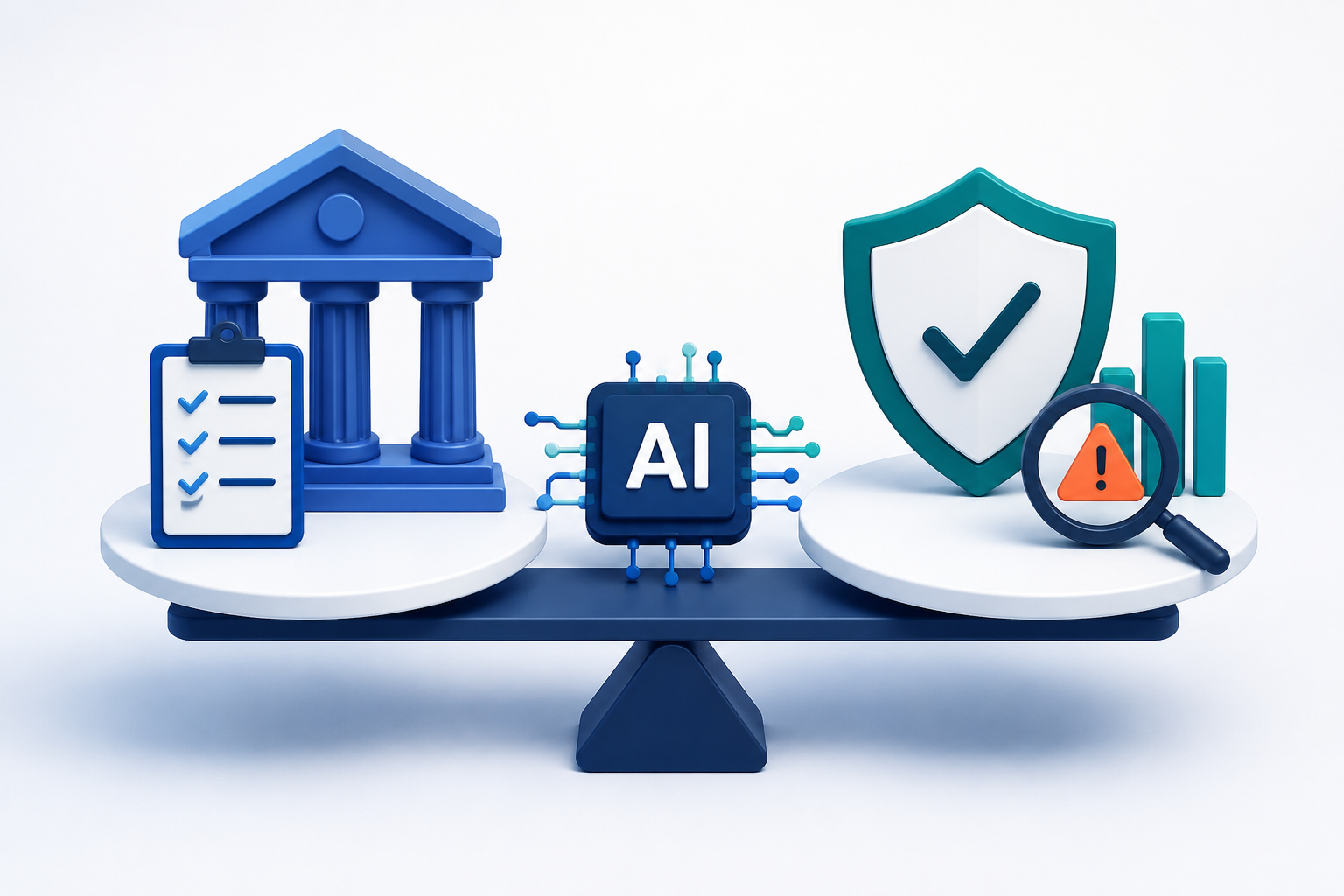
AI Governance vs AI Risk Management: What’s the Difference?
Artificial intelligence is rapidly becoming part of everyday business operations.
Organizations are using AI to automate repetitive tasks, improve decision-making, analyze large amounts of information, and assist employees across nearly every industry.
As AI adoption continues to grow, so does the need to manage AI responsibly.
Two terms appear in almost every conversation about responsible AI:
and
Although these concepts are closely related, they are not the same thing.
In fact, one of the most common misconceptions in AI literacy is assuming they mean the same thing.
Understanding the difference helps organizations build AI systems that are not only effective but also trustworthy, accountable, and sustainable.
Why People Confuse AI Governance And AI Risk Management
The confusion is understandable.
Both governance and risk management focus on responsible AI.
Both involve oversight.
Both involve documentation.
Both help organizations reduce potential problems.
Both continue throughout the AI Lifecycle.
Because they work so closely together, many people use the terms interchangeably.
A helpful way to think about it is driving a car.
Traffic laws exist to create an overall system for safe driving.
Seatbelts, airbags, and brakes reduce the risks while driving.
One establishes the rules.
The other reduces the danger.
Organizations manage AI in much the same way.
What Is AI Governance?
AI governance is the overall framework an organization uses to manage artificial intelligence responsibly.
Rather than focusing on one AI system, governance looks at the entire organization.
It establishes:
- Policies
- Roles
- Responsibilities
- Oversight
- Standards
- Decision-making processes
Governance helps ensure AI is developed, deployed, monitored, and retired consistently across the organization.
It also creates accountability.
When important AI decisions are made, governance helps answer questions such as:
- Who approved this AI system?
- Who owns the model?
- Who monitors performance?
- Who responds if problems occur?
- How should AI be reviewed before deployment?
Without governance, organizations often develop AI in inconsistent ways.
Different teams may follow different standards.
Documentation may be incomplete.
Oversight may disappear entirely.
Governance helps create consistency.
Governance Is About Organizational Direction
Governance focuses on the bigger picture.
It establishes how AI should be managed throughout the organization.
It considers topics such as:
- Ethical AI
- Organizational accountability
- Documentation
- Human oversight
- Transparency
- Compliance
- Policies
- Decision-making
Rather than asking,
“How do we fix this model?”
governance asks,
“How should our organization manage AI responsibly?”
This distinction becomes increasingly important as organizations deploy dozens—or even hundreds—of AI systems.
What Is AI Risk Management?
If governance establishes the framework, AI risk management focuses on identifying and reducing uncertainty.
Every AI system introduces risk.
Training data may contain bias.
Models may become less accurate over time.
Sensitive information may be exposed.
Regulations may change.
Cybersecurity threats may emerge.
AI risk management helps organizations understand these risks before they become significant problems.
Instead of eliminating every possible risk—which is impossible—organizations work to identify risks, evaluate their impact, implement safeguards, and continuously monitor AI systems.
AI Risk Exists Throughout The AI Lifecycle
Many people assume AI risk begins after deployment.
It actually begins much earlier.
Risk can appear during:
- Data collection
- Model development
- Training
- Evaluation
- Deployment
- Continuous monitoring
For example, poor-quality training data may introduce bias before a model is ever deployed.
Likewise, an accurate model today may become less reliable next year as customer behavior changes.
This gradual decline is often associated with Model Drift.
Organizations that continuously monitor AI systems are much more likely to identify these problems early.
The Types Of AI Risk Organizations Manage
AI risk is not limited to cybersecurity.
Organizations manage many different categories of risk simultaneously.
Data Risk
Artificial intelligence depends on data.
Poor-quality data usually produces poor-quality AI.
Incomplete information.
Historical bias.
Incorrect labels.
Outdated datasets.
All of these reduce model reliability.
This is one reason Data Governance plays such an important role in responsible AI.
Security Risk
AI introduces new security considerations alongside traditional cybersecurity.
Organizations must protect:
- Training data
- AI models
- APIs
- Infrastructure
- User information
Modern AI systems may also become targets for attacks such as Prompt Injection, unauthorized access, or model theft.
Security remains one of the most important components of responsible AI adoption.
Fairness Risk
AI learns from historical information.
If historical data reflects existing bias, AI systems may unintentionally reproduce those same patterns.
Organizations increasingly evaluate AI systems for fairness before and after deployment.
Fairness is not a one-time test.
It requires continuous evaluation.
Privacy Risk
Many AI systems process personal or confidential information.
Organizations must ensure sensitive data is collected, stored, processed, and protected responsibly.
Privacy considerations should be incorporated into AI systems from the beginning rather than added later.
Operational Risk
AI systems change.
Businesses change.
Markets change.
Customer behavior changes.
Because AI operates in dynamic environments, organizations must continuously evaluate whether models continue performing as expected.
Without monitoring, performance can gradually decline while remaining unnoticed.
Compliance Risk
Governments around the world are introducing new AI regulations.
Organizations increasingly need documented governance processes, accountability, transparency, and oversight.
Strong AI risk management helps organizations prepare for evolving regulatory expectations while demonstrating responsible AI practices.
Governance Creates The Rules. Risk Management Applies Them.
One of the easiest ways to understand the relationship between governance and risk management is to view governance as the organizational framework.
Risk management operates within that framework.
Governance might require every AI system to undergo formal review before deployment.
Risk management performs that review.
Governance may require ongoing monitoring.
Risk management monitors performance.
Governance establishes accountability.
Risk management identifies and responds to emerging risks.
They are different responsibilities.
But they work together continuously.
A Real-World Example
Imagine a bank introducing an AI system to assist with loan approvals.
The organization has already established an AI Governance framework.
Its governance policies require every AI system to be reviewed before deployment, documented appropriately, monitored after launch, and periodically audited.
Now the AI risk management team begins its work.
They identify potential risks, including:
- Historical lending data contains bias.
- Customer information requires stronger privacy protections.
- Certain high-risk decisions should include Human Oversight.
- Model performance could decline as economic conditions change.
- Security controls need to protect the model from unauthorized access.
To reduce these risks, the organization:
- Reviews the quality of training data.
- Tests the model for fairness.
- Implements security controls.
- Documents model decisions.
- Continuously monitors performance after deployment.
The governance framework defines what should happen.
The risk management program determines how risks will be identified and managed.
Together, they create a responsible approach to AI adoption.
Why Both Matter
Organizations often focus first on whether AI works.
Can the model generate accurate predictions?
Can it automate repetitive work?
Can it improve productivity?
Those are important questions.
However, responsible AI requires organizations to ask additional questions.
Can we explain how this AI reaches its decisions?
Who is accountable if something goes wrong?
Are we protecting sensitive information?
How do we know the model is still performing well six months from now?
How do we demonstrate compliance with evolving regulations?
These questions extend beyond technology.
They involve leadership, oversight, accountability, and organizational processes.
That is why governance and risk management have become central to responsible AI.
Governance And Risk Management Support Trust
Successful AI adoption depends on trust.
Employees need confidence that AI supports their work.
Customers need confidence that AI systems operate fairly.
Executives need confidence that organizational risks remain under control.
Regulators need confidence that AI is being managed responsibly.
Trust is not created by a single policy.
Nor is it created by a single risk assessment.
It develops through consistent governance, continuous monitoring, strong documentation, effective communication, and responsible decision-making.
Organizations that invest in these capabilities are better prepared to scale AI responsibly.
Looking Ahead
Artificial intelligence will continue becoming part of everyday business operations.
Organizations will deploy AI across finance, healthcare, education, manufacturing, retail, government, and countless other industries.
As adoption grows, responsible management becomes increasingly important.
Governance provides the framework.
Risk management helps protect the organization within that framework.
Rather than competing with one another, the two disciplines work together to support safe, transparent, and trustworthy AI.
Understanding both concepts is becoming an essential part of AI literacy for professionals, business leaders, students, and anyone helping shape the future of artificial intelligence.
Key Takeaways
- AI Governance establishes the policies, accountability, and oversight that guide responsible AI.
- AI Risk Management identifies, assesses, monitors, and reduces AI-related risks.
- Governance focuses on the organization as a whole, while risk management focuses on specific risks affecting AI systems.
- AI risk exists throughout the AI Lifecycle, not only after deployment.
- Governance and risk management work together to build trustworthy, transparent, and responsible AI.
- Organizations need both to support long-term AI adoption.
Conclusion
Artificial intelligence is no longer simply a technology project.
It is becoming an organizational capability.
As AI systems influence more business decisions, organizations need clear governance structures and effective risk management processes to support responsible adoption.
AI governance provides the direction.
AI risk management provides the discipline.
Together, they help organizations innovate with confidence while protecting customers, employees, and the business itself.
Understanding the difference between these concepts is one of the foundations of modern AI literacy.
As AI continues to evolve, organizations that strengthen both governance and risk management will be better positioned to build AI systems that people can trust.
Related Concepts
- AI Governance
- AI Risk Management
- AI Lifecycle
- Human Oversight
- Data Governance
- Model Drift
- Prompt Injection
- Responsible AI
- AI Compliance
- AI Auditing
Related Articles
- What Is AI Risk Management?
- What AI Governance Actually Means
- Why AI Governance Matters As AI Adoption Grows
- Responsible AI Without Fearmongering
- Why AI Security Starts With Fundamentals
- How AI Models Go From Training To Production
- Why AI Models Need Continuous Monitoring