June 13, 2026
How AI Models Go From Training To Production
When most people hear about artificial intelligence, they focus on the model itself. A chatbot. An image generator. A recommendation engine. A reasoning model. But before any AI system can be used in the real world, it must move from training to production. This process requires infrastructure, deployment, monitoring, and ongoing management. In this article, we'll explore how AI models make that journey and why technologies such as GPUs, inference servers, model deployment, and MLOps are becoming increasingly important.
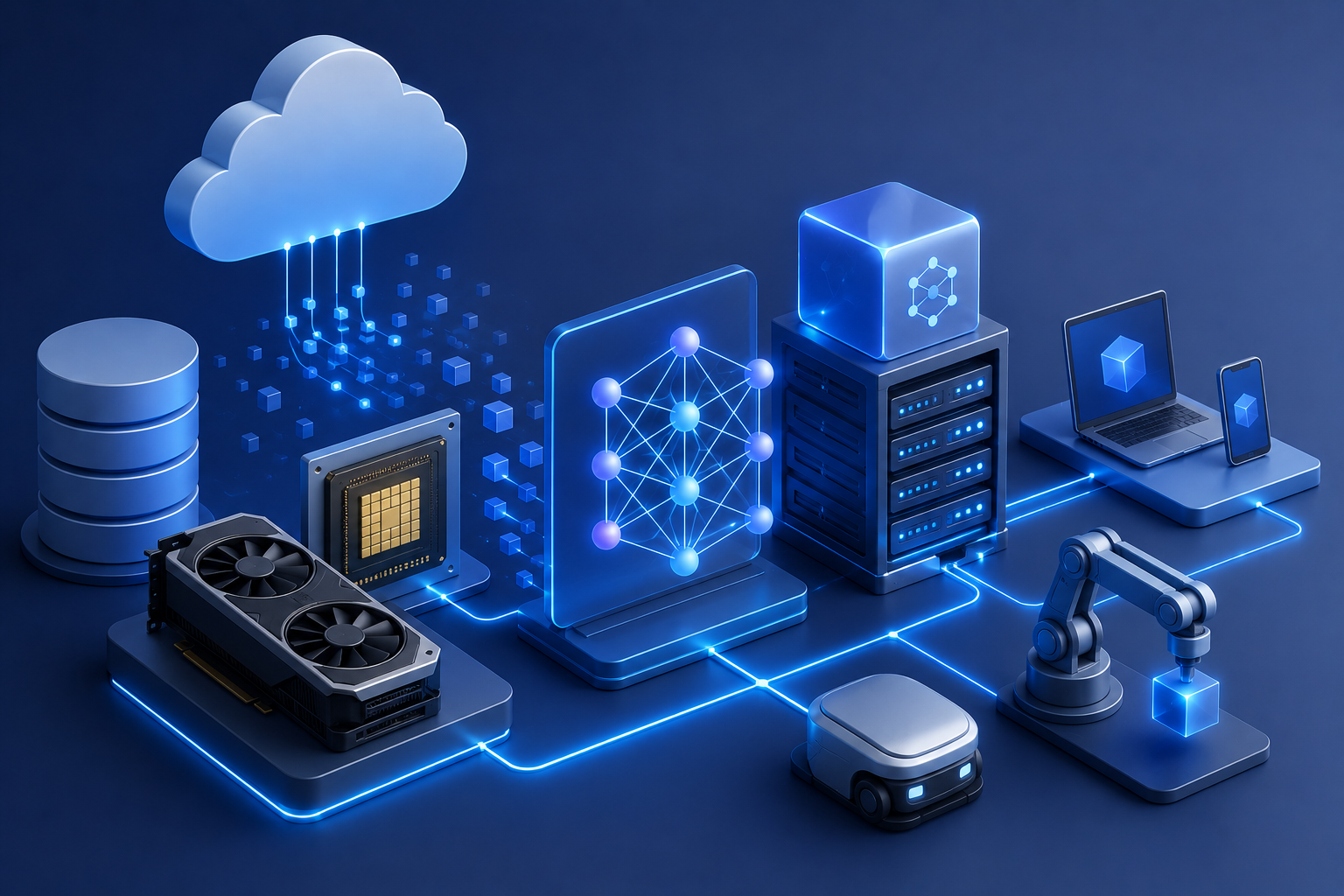
How AI Models Go From Training To Production
Training an AI model is only the beginning.
Many discussions about artificial intelligence focus on how models learn.
How they process data.
How they identify patterns.
How they improve performance.
While these topics are important, a trained model provides little value if nobody can use it.
For an AI system to generate content, answer questions, make predictions, or support business operations, it must be deployed into a real-world environment.
This transition from training to production is where AI infrastructure becomes essential.
Without the right infrastructure, even the most capable AI model remains little more than an experiment.
Training Requires Powerful Hardware
Modern AI systems process enormous amounts of information.
Training a large model can require billions or even trillions of calculations.
Traditional computer processors can perform these calculations, but they are often too slow for large-scale AI workloads.
This is why many organizations rely on GPUs.
Originally designed for graphics processing, GPUs excel at performing large numbers of calculations simultaneously.
This makes them particularly useful for training machine learning and deep learning models.
Some organizations also use TPUs.
TPUs, or Tensor Processing Units, are specialized processors designed specifically for AI and machine learning tasks.
Both technologies help accelerate training and make large-scale AI development possible.
Training And Deployment Are Different
A common misconception is that training and deployment are the same thing.
They are not.
Training teaches a model how to perform a task.
Deployment makes that model available for use.
A helpful way to think about it is earning a driver’s license.
Learning to drive is training.
Driving passengers every day is deployment.
The same principle applies to AI.
Once a model has been trained, organizations must determine how users and applications will access it.
This process is known as Model Deployment.
Deployment transforms a trained model into a usable service.
Without deployment, the model cannot deliver value.
What Happens During Inference
After deployment, the model begins receiving requests.
A user asks a question.
An application submits information.
A business system requests a prediction.
The model generates a response.
This process is known as Inference.
Inference is different from training.
The model is no longer learning.
Instead, it is applying what it has already learned.
Because modern AI systems often serve thousands or even millions of requests, organizations typically use an Inference Server to manage these interactions.
An inference server hosts the model and processes incoming requests efficiently.
A helpful way to think about it is a restaurant kitchen.
Customers place orders.
The kitchen prepares meals.
Similarly, applications submit requests and the inference server generates responses.
The Infrastructure Behind AI
Most people never see the infrastructure supporting AI systems.
Yet it plays a critical role.
Modern AI Infrastructure often includes:
- GPUs and TPUs
- Cloud computing resources
- Databases
- Networking systems
- Storage platforms
- Monitoring tools
- Security controls
- Inference servers
Together, these components allow AI systems to operate reliably at scale.
A chatbot serving millions of users requires far more than a model alone.
It requires an entire ecosystem of supporting technologies.
This infrastructure is what allows AI applications to move from prototypes to production systems.
The Rise Of Edge AI
Not all AI systems operate entirely in the cloud.
Increasingly, organizations are adopting Edge AI.
Edge AI refers to running AI models directly on local devices rather than relying exclusively on remote infrastructure.
Smartphones.
Vehicles.
Industrial equipment.
Medical devices.
These systems often process information closer to where it is generated.
This can reduce latency, improve responsiveness, and enhance privacy.
As hardware continues to improve, edge AI is expected to become increasingly common across many industries.
Why MLOps Matters
Deploying an AI model is not the end of the process.
Models require maintenance.
Monitoring.
Updates.
Performance evaluation.
Security reviews.
This is where MLOps becomes important.
MLOps stands for Machine Learning Operations.
It refers to the practices used to deploy, manage, monitor, and improve machine learning systems in production environments.
A helpful way to think about MLOps is maintaining a vehicle.
Purchasing the vehicle is only the beginning.
Ongoing maintenance keeps it operating effectively.
Similarly, MLOps helps organizations ensure AI systems remain reliable over time.
As AI adoption grows, MLOps is becoming a critical discipline for organizations deploying AI at scale.
Why This Matters For AI Literacy
Most people will never train a large AI model.
Many will never manage AI infrastructure.
Yet understanding these concepts remains valuable.
When people interact with AI systems, they often see only the final result.
A response.
An image.
A recommendation.
A prediction.
Behind every output is a complex infrastructure that enables the system to operate.
Understanding deployment, inference, infrastructure, and MLOps provides a more complete picture of how modern AI actually works.
It helps move conversations beyond models alone and toward the systems that make AI possible.
Key Takeaways
- Training and deployment are different stages of the AI lifecycle.
- GPUs and TPUs provide the computing power needed for many AI workloads.
- Model deployment makes trained models available for real-world use.
- Inference occurs when a deployed model generates outputs.
- Inference servers help manage requests efficiently.
- AI infrastructure includes hardware, software, networking, storage, and cloud services.
- Edge AI allows models to operate directly on local devices.
- MLOps helps organizations maintain and improve AI systems over time.
Conclusion
Artificial intelligence is often discussed in terms of models.
But models are only one part of the story.
For AI systems to deliver value, they must be deployed, hosted, monitored, and maintained.
This requires infrastructure.
It requires operations.
It requires ongoing management.
Understanding how AI models move from training to production helps explain how modern AI systems actually function.
And as AI becomes increasingly integrated into everyday life, that understanding is becoming an important part of AI literacy.