What Are Large Language Models (LLMs)?
Large Language Models (LLMs) are the technology behind many of today's most popular artificial intelligence tools. Whether you're using ChatGPT, Claude, Gemini, Microsoft Copilot, or another conversational AI assistant, you're interacting with a Large Language Model.
These systems can answer questions, summarize documents, write software code, translate languages, explain complex concepts, and generate human-like conversations. While their capabilities often appear remarkable, they are built on the same fundamental AI principles discussed in earlier articles.
Understanding what an LLM is—and what it is not—is an important step toward becoming AI literate.
This article explains how Large Language Models work, why they are called "large," where they are used, and their strengths and limitations.
What Is a Large Language Model?
A Large Language Model is a deep learning model trained to understand and generate human language.
Unlike traditional software that follows explicit rules, an LLM learns statistical patterns by analyzing enormous collections of text.
During training, the model studies relationships between words, phrases, sentences, and ideas.
Over time, it becomes increasingly effective at predicting what text should come next.
This ability allows LLMs to:
- Answer questions
- Explain concepts
- Generate software code
- Summarize documents
- Translate languages
- Write emails
- Brainstorm ideas
- Hold conversations
Although they appear conversational, LLMs are fundamentally prediction engines.
Why Are They Called "Large"?
The word large refers to both the scale of the model and the amount of data used during training.
Modern LLMs often contain billions—or even hundreds of billions—of parameters.
Parameters are the internal numerical values the model adjusts during training.
The more parameters a model has, the more complex patterns it can potentially learn.
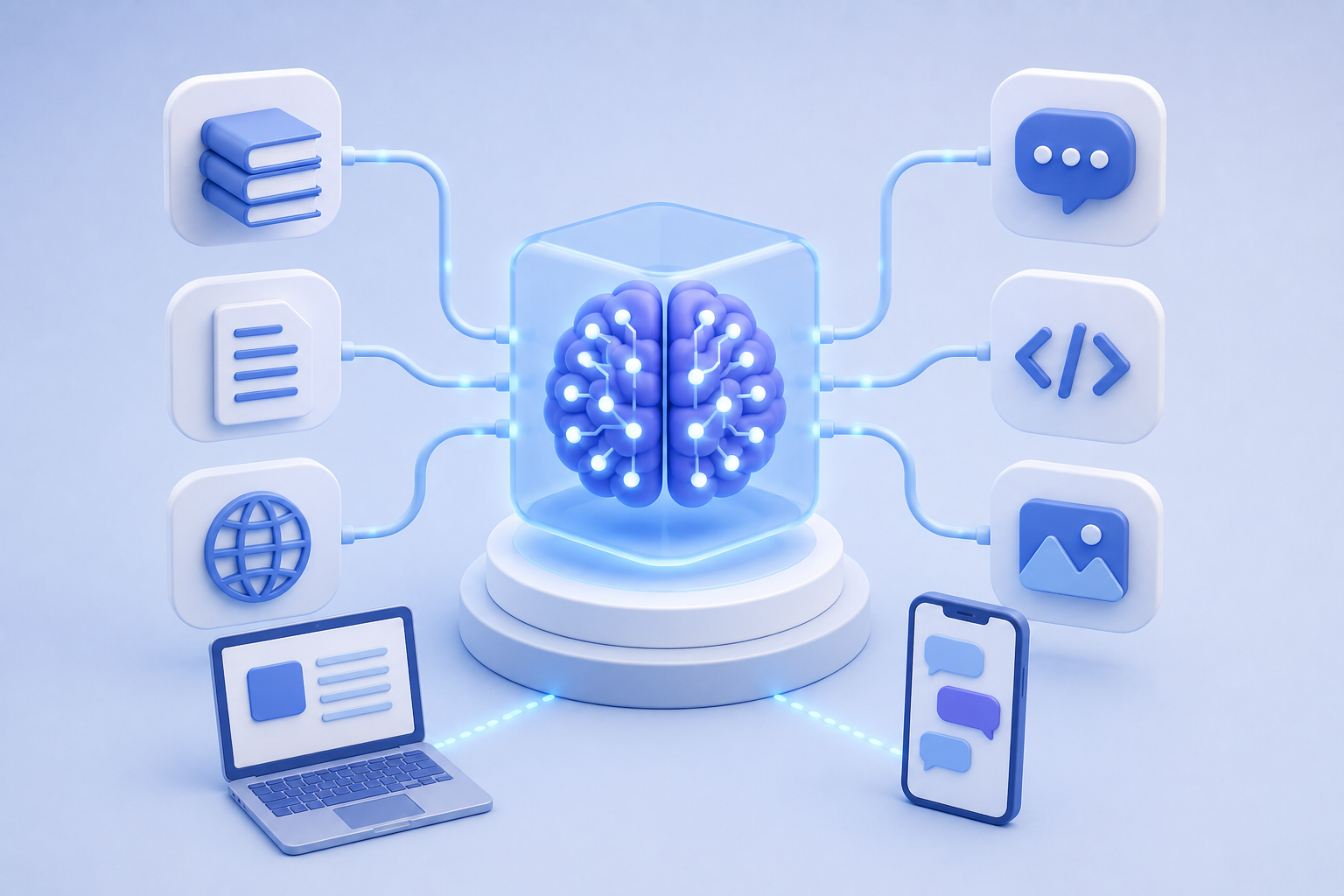
Large models are also trained on enormous datasets that may include:
- Books
- Academic papers
- Articles
- Websites
- Computer code
- Technical documentation
- Publicly available text
The combination of massive datasets and large numbers of parameters gives these models their impressive capabilities.
How Do Large Language Models Work?
At a high level, an LLM performs one primary task:
It predicts the next most likely piece of text.
Suppose you type:
"The capital of France is..."
The model evaluates many possible next words and predicts the one that best fits the context.
It repeats this prediction process one token at a time until it produces a complete response.
Although the mathematics behind this process is highly sophisticated, the underlying idea remains simple:
Predict.
Generate.
Repeat.
Every sentence produced by an LLM is built through this continuous prediction process.
Tokens: How AI Reads Language
Humans naturally think in words and sentences.
LLMs process language differently.
Instead of reading complete words, they break text into smaller units called tokens.
A token might represent:
- A complete word
- Part of a word
- A punctuation mark
- A number
- A symbol
For example:
Artificial Intelligence is transforming healthcare.
The model processes this sentence as a sequence of tokens rather than one complete thought.
Working with tokens allows LLMs to efficiently process many different languages and writing styles.
The Transformer Architecture
Modern LLMs are built using a neural network architecture called the Transformer.
Introduced in 2017, the Transformer dramatically improved how AI models understand language.
Rather than processing text one word at a time, Transformers analyze relationships between words across an entire sentence.
For example, in the sentence:
"The doctor thanked the nurse because she helped the patient."
The model can determine that "she" refers to the nurse rather than the patient.
This ability to understand context makes Transformers far more effective than earlier language models.
Today, nearly every major LLM is based on Transformer architecture.
What Can Large Language Models Do?
Modern LLMs support an extraordinary range of tasks.
Common applications include:
- Writing reports
- Summarizing documents
- Generating software code
- Answering technical questions
- Brainstorming ideas
- Creating lesson plans
- Translating languages
- Drafting emails
- Explaining scientific concepts
- Assisting customer support
Because they are general-purpose models, a single LLM can often perform many different tasks without requiring separate software.
What Large Language Models Cannot Do
Despite their capabilities, LLMs have important limitations.
They do not:
- Think like humans
- Possess consciousness
- Understand concepts exactly as people do
- Verify every fact before responding
- Know everything
- Reason perfectly in every situation
Instead, they generate responses by predicting statistically likely sequences of language.
This means they can occasionally produce incorrect or fabricated information, often called hallucinations.
Human review remains essential, especially for medical, legal, financial, engineering, and scientific decisions.
Where Are LLMs Used?
Large Language Models are rapidly becoming part of everyday software.
Examples include:
Education
Helping students learn new concepts and generate study materials.
Healthcare
Assisting clinicians with documentation and medical research.
Software Development
Generating code, explaining programming concepts, and assisting debugging.
Business
Drafting reports, analyzing documents, and improving productivity.
Customer Support
Answering common questions through intelligent virtual assistants.
Scientific Research
Summarizing literature and assisting researchers with information retrieval.
Their versatility is one reason LLMs are transforming so many industries.
Why LLMs Matter
Large Language Models represent one of the most significant advances in artificial intelligence.
Rather than building separate AI systems for every task, organizations can use a single foundation model for hundreds of different applications.
This flexibility has accelerated AI adoption across nearly every industry.
As models continue improving, they are becoming more capable, more accurate, and increasingly integrated into everyday tools used by businesses, researchers, educators, and individuals around the world.
Looking Ahead
Large Language Models continue to evolve rapidly.
Researchers are improving reasoning abilities, expanding multimodal capabilities, reducing computational requirements, and making models more reliable and efficient.
Future AI systems will increasingly combine language understanding with vision, audio, robotics, scientific reasoning, and autonomous decision-making.
Understanding how LLMs work provides an important foundation for understanding the next generation of AI technologies.
Key Takeaways
- Large Language Models are deep learning systems designed to understand and generate human language.
- They learn statistical relationships from enormous collections of text during training.
- LLMs generate responses by predicting one token at a time.
- Modern LLMs are built using Transformer architecture.
- They power AI assistants such as ChatGPT, Claude, Gemini, and Microsoft Copilot.
- LLMs support writing, coding, translation, summarization, tutoring, and many other applications.
- They are powerful but can still produce incorrect information.
- Understanding LLMs is essential for understanding today's AI landscape.
Related Articles
- What Is Artificial Intelligence? A Beginner's Guide
- Artificial Intelligence vs Machine Learning vs Deep Learning vs Generative AI
- How AI Models Learn: Training, Fine-Tuning, and Inference Explained
- Prompt Engineering Fundamentals
- Understanding AI Agents
Final Thoughts
Large Language Models have fundamentally changed how people interact with computers. Instead of learning complex software interfaces, users can increasingly communicate using natural language.
While LLMs are not intelligent in the human sense, they represent a major milestone in artificial intelligence. By understanding how they learn, generate language, and support real-world applications, readers are well prepared to explore more advanced AI topics in the articles ahead.