How AI Models Learn: Training, Fine-Tuning, and Inference Explained
Artificial intelligence can answer questions, recognize images, generate software code, translate languages, and even create artwork. But one of the biggest questions beginners ask is:
How does AI actually learn?
Unlike humans, AI does not read books, attend school, or gain experience through everyday life. Instead, AI learns by analyzing enormous amounts of data using mathematical algorithms and powerful computers.
Understanding how AI models learn is one of the most important concepts in artificial intelligence. It explains why AI performs so well in some situations, why it sometimes makes mistakes, and why newer AI models continue to improve over time.
This article explores the three major stages of an AI model's lifecycle:
- Training
- Fine-Tuning
- Inference
Together, these stages form the foundation of nearly every modern AI system.
The AI Learning Lifecycle
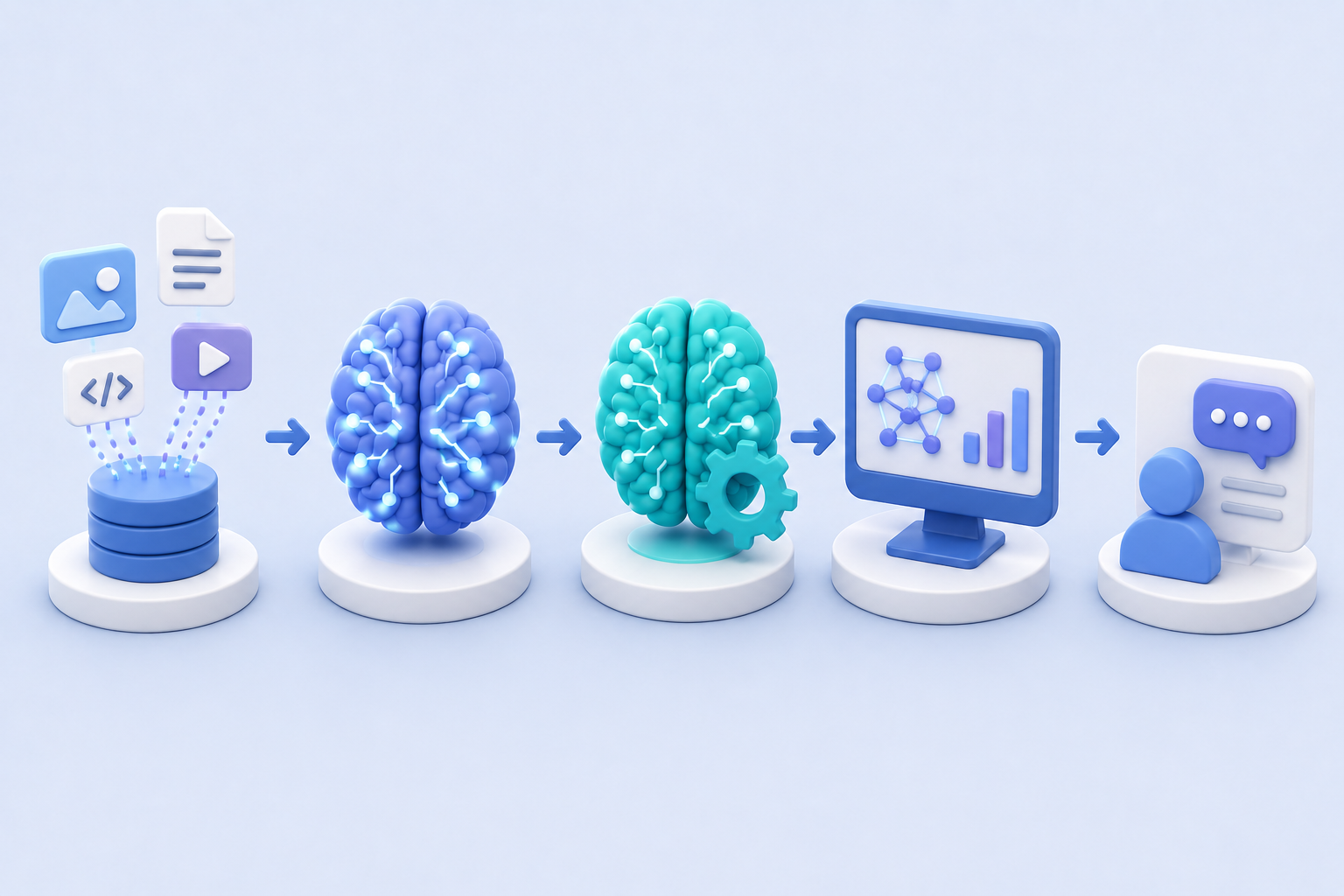
Every modern AI model follows a similar process.
Collect Data
      ↓
Train the Model
      ↓
Fine-Tune the Model
      ↓
Deploy the Model
      ↓
Users Interact (Inference)
Although different AI models use different techniques, the overall lifecycle remains remarkably similar.
Let's examine each stage individually.
Step 1 — Collecting Data
Before an AI model can learn anything, it needs data.
Lots of data.
Depending on the application, this may include:
- Books
- Articles
- Research papers
- Images
- Videos
- Audio recordings
- Medical records
- Satellite imagery
- Computer code
- Scientific datasets
The quality of the data largely determines how well the AI performs.
An AI trained on inaccurate, biased, or incomplete information will often produce inaccurate results.
This is why collecting, cleaning, and organizing data is one of the most important stages in AI development.
Many AI projects spend significantly more time preparing data than building the AI model itself.
Step 2 — Training the Model
Training is where the actual learning happens.
During training, developers expose the AI model to enormous datasets.
The model begins making predictions.
Initially, those predictions are mostly incorrect.
The system then measures how wrong it was.
Using mathematical optimization techniques, it adjusts millions—or even billions—of internal parameters.
It repeats this process again...
and again...
and again.
Sometimes trillions of times.
With every iteration, the model gradually improves.
Eventually it begins recognizing increasingly complex patterns within the data.
This entire process is known as training.
What Is the AI Actually Learning?
A common misconception is that AI memorizes information.
In reality, modern AI learns statistical relationships.
For example, after analyzing millions of sentences, a language model begins learning:
- Grammar
- Sentence structure
- Word relationships
- Context
- Writing styles
- Facts appearing frequently together
Similarly, image models learn relationships between:
- Shapes
- Colors
- Textures
- Objects
- Lighting
- Spatial arrangements
Rather than memorizing every example, successful models learn general patterns that allow them to perform well on new data.
Why Training Takes So Long
Training today's largest AI models requires extraordinary computing resources.
Large AI models may require:
- Thousands of GPUs
- Massive data centers
- Weeks or months of computation
- Enormous electrical power
- Petabytes of training data
Training one frontier AI model can cost millions of dollars.
This is one reason why only a relatively small number of organizations currently train the world's largest foundation models from scratch.
Step 3 — Fine-Tuning
Once a model has completed general training, developers often improve it for specific tasks.
This process is called fine-tuning.
Imagine graduating from medical school.
You understand general medicine.
Later you specialize in:
- Cardiology
- Neurology
- Oncology
- Pediatrics
Fine-tuning works similarly.
A general AI model can later become specialized for:
- Legal research
- Medical diagnosis
- Financial analysis
- Software development
- Customer support
- Scientific research
Instead of starting over, developers continue training the existing model using carefully selected domain-specific data.
This allows the model to become much better within a particular field.
Step 4 — Inference
After training and fine-tuning are complete, the model is deployed.
Now users begin interacting with it.
This stage is called inference.
Inference simply means the model is using what it already learned.
For example:
You ask:
"Explain cloud computing."
The AI does not begin learning from scratch.
Instead, it applies the knowledge already acquired during training and generates an answer.
Every time you:
- Ask ChatGPT a question
- Generate an image
- Translate a sentence
- Request software code
- Summarize a document
you are using inference.
Inference is typically much faster and far less computationally expensive than training.
Does AI Continue Learning?
This is an important distinction.
Most deployed AI models do not continuously learn from every user conversation.
Instead:
- The model is trained.
- It is deployed.
- Users perform inference.
If developers want the model to improve, they usually perform another training or fine-tuning cycle using new datasets.
This controlled approach improves reliability, security, and consistency.
Why AI Sometimes Makes Mistakes
Even highly advanced AI models occasionally produce incorrect information.
Several factors contribute to this:
- Limited training data
- Outdated information
- Ambiguous prompts
- Statistical prediction errors
- Missing context
- Biases in training data
Because AI predicts probable outputs rather than reasoning exactly like humans, mistakes remain possible.
This is why human oversight continues to be essential in high-stakes applications such as healthcare, law, finance, and engineering.
The Complete Learning Process
Putting everything together, an AI model typically follows this lifecycle:
Massive Dataset
       ↓
Training
       ↓
General AI Model
       ↓
Fine-Tuning
       ↓
Specialized AI Model
       ↓
Deployment
       ↓
Inference
       ↓
User Responses
Understanding this lifecycle makes it much easier to understand discussions about modern AI systems.
Whenever you hear terms like foundation model, fine-tuned model, or inference endpoint, they all refer to different stages of this process.
Looking Ahead
As AI models become larger and more capable, researchers continue improving every stage of the learning process.
New techniques are making training faster, reducing computational costs, improving fine-tuning efficiency, and enabling AI models to perform more specialized tasks with less data.
Although the underlying mathematics is incredibly complex, the overall learning process remains surprisingly straightforward:
First, AI learns from data.
Then it specializes.
Finally, it applies that knowledge to help users solve problems.
Key Takeaways
- AI models learn from data rather than explicit programming.
- Training is the process where the model discovers statistical patterns.
- Fine-tuning specializes a general model for specific tasks or industries.
- Inference is the process of using a trained model to generate predictions or responses.
- Most deployed AI systems do not continuously learn from every interaction.
- High-quality data is one of the most important factors affecting AI performance.
- Training requires enormous computing resources, while inference is comparatively efficient.
- Understanding the AI learning lifecycle provides a foundation for understanding modern AI systems.
Related Articles
- What Is Artificial Intelligence? A Beginner's Guide
- Artificial Intelligence vs Machine Learning vs Deep Learning vs Generative AI
- What Are Large Language Models (LLMs)?
- Prompt Engineering Fundamentals
- Understanding AI Agents
Final Thoughts
Artificial intelligence may appear almost magical, but every modern AI system follows a structured learning process. It begins with data, improves through training, becomes more specialized through fine-tuning, and finally serves users through inference.
Once you understand this lifecycle, many of the terms used throughout the AI industry become much easier to understand. Whether you're reading about language models, medical AI, autonomous vehicles, or robotics, the same core principles apply: learn, specialize, and perform.