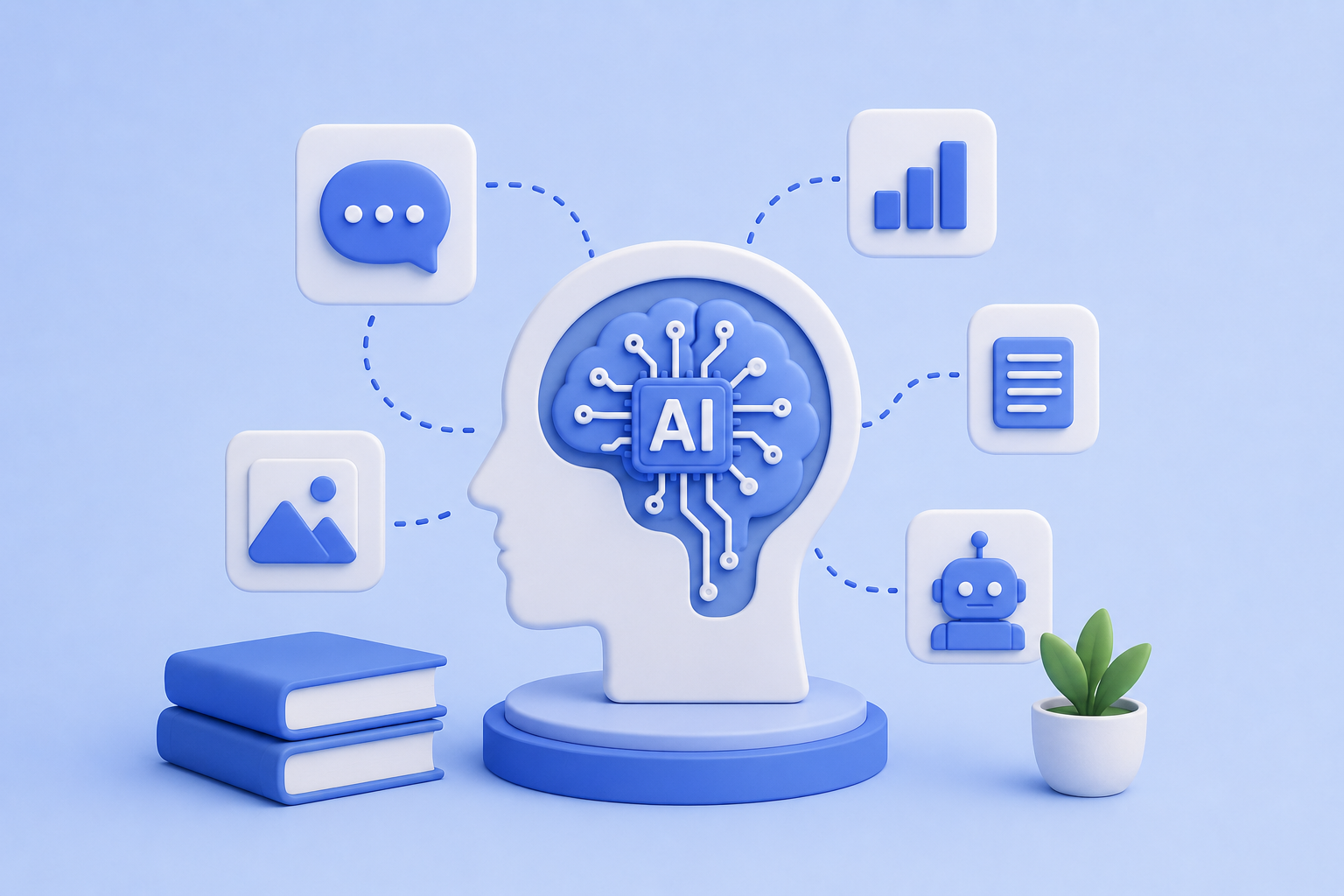
What Is Artificial Intelligence? A Beginner's Guide
Artificial Intelligence (AI) has rapidly become one of the most transformative technologies of the modern era. It powers the tools we use every day, influences business decisions across industries, assists scientists in medical research, enables self-driving vehicles, and helps organizations automate tasks that once required human effort.
Despite its growing presence, AI remains widely misunderstood. Many people associate artificial intelligence with science fiction, human-like robots, or futuristic machines replacing people. In reality, today's AI is far more specialized. Most AI systems are designed to perform specific tasks rather than think or reason like humans.
Understanding artificial intelligence has become an essential skill—not only for software developers and engineers, but also for business professionals, healthcare workers, educators, government leaders, cybersecurity specialists, and anyone who uses modern technology.
This article introduces the fundamentals of artificial intelligence, explains how AI works at a high level, explores where it is used today, discusses common misconceptions, and highlights why AI literacy is becoming increasingly valuable.
What Is Artificial Intelligence?
Artificial Intelligence is the field of computer science focused on creating systems capable of performing tasks that normally require human intelligence.
These tasks may include:
- Understanding language
- Recognizing images
- Identifying patterns
- Learning from data
- Making predictions
- Solving problems
- Assisting with decision-making
Rather than following only fixed instructions written by programmers, many modern AI systems learn patterns from data. This allows them to improve performance on specific tasks without explicitly programming every possible scenario.
Traditional software follows rules written by humans.
Artificial intelligence discovers patterns from data.
This distinction explains why AI excels at tasks that would be extremely difficult to solve using traditional programming alone.
AI Is Not One Technology
Many people speak about AI as though it were a single technology.
In reality, artificial intelligence is an umbrella term that includes many different disciplines and techniques.
Some of the major areas include:
- Machine Learning
- Deep Learning
- Natural Language Processing (NLP)
- Computer Vision
- Robotics
- Expert Systems
- Reinforcement Learning
- Speech Recognition
- Generative AI
Each area solves different kinds of problems.
For example:
- Computer Vision allows computers to understand images.
- Natural Language Processing helps computers understand and generate human language.
- Machine Learning enables systems to improve through experience.
- Generative AI creates entirely new content such as text, images, audio, software code, and videos.
Understanding these categories helps explain why AI applications vary so widely across industries.
How AI Learns
Modern AI systems typically learn from large amounts of data.
Imagine teaching a child to recognize cats.
Rather than explaining every possible feature, you would simply show thousands of examples.
Eventually, the child begins recognizing patterns independently.
Machine learning works similarly.
Developers provide:
- Large datasets
- Learning algorithms
- Computing power
The AI system analyzes millions—or even billions—of examples and gradually learns statistical relationships within the data.
Instead of memorizing answers, successful AI models identify patterns that allow them to make predictions on new information they have never seen before.
This process is called training.
After training, the model can perform inference, meaning it applies what it has learned to new inputs.
Artificial Intelligence vs Traditional Programming
Understanding the difference between traditional software and AI helps explain why AI has become so powerful.
Traditional software follows explicit instructions written by programmers.
For example:
IF temperature > 30°C
THEN turn on air conditioner
Every possible situation must be anticipated and programmed manually.
AI approaches the problem differently.
Instead of writing every rule, developers provide examples.
The AI discovers patterns automatically.
This allows AI to solve problems that are difficult or impossible to describe using fixed rules, including:
- Recognizing faces
- Translating languages
- Detecting fraud
- Understanding speech
- Predicting customer behavior
AI complements traditional software rather than replacing it.
Most modern applications combine both approaches.
Where AI Is Used Today
Artificial intelligence already powers many technologies people use daily, often without realizing it.
Healthcare
AI assists physicians by helping detect diseases from medical images, supporting clinical decision-making, accelerating drug discovery, and improving patient care.
Finance
Banks use AI to identify fraudulent transactions, assess financial risk, automate customer support, and detect unusual account activity.
Manufacturing
Factories use AI for predictive maintenance, quality inspection, robotics, and production optimization.
Transportation
AI supports navigation systems, traffic prediction, autonomous vehicle research, fleet optimization, and logistics planning.
Education
Learning platforms personalize lessons, recommend educational resources, generate practice questions, and provide tutoring assistance.
Cybersecurity
Security teams use AI to detect malware, identify suspicious behavior, analyze network traffic, and respond to emerging threats faster.
Retail
Businesses recommend products, forecast inventory, personalize shopping experiences, and improve customer service.
Scientific Research
Researchers use AI to analyze massive datasets, simulate experiments, accelerate discoveries, and identify patterns humans might overlook.
What AI Can—and Cannot—Do
Artificial intelligence is impressive, but it has important limitations.
Today's AI systems are generally narrow AI, meaning they are designed for specific tasks.
An AI that excels at medical image analysis cannot suddenly become a financial advisor or engineer without additional training.
Current AI does not possess:
- Human consciousness
- Self-awareness
- Genuine understanding
- Independent desires
- Human emotions
Instead, AI models identify statistical patterns in data and generate outputs based on those patterns.
Even advanced systems can produce incorrect information, misunderstand context, or generate convincing but inaccurate answers.
Human oversight remains essential.
Common Misconceptions About AI
"AI thinks like humans."
Not exactly.
Modern AI predicts patterns rather than reasoning exactly as humans do.
"AI knows everything."
No.
AI systems are limited by their training data, architecture, and available information.
"AI will replace every job."
History suggests technology changes work rather than simply eliminating it.
Many professions will evolve as AI automates repetitive tasks while increasing demand for human judgment, creativity, leadership, and specialized expertise.
"AI is only for programmers."
AI affects nearly every profession.
Understanding its capabilities and limitations benefits professionals in healthcare, business, education, law, government, cybersecurity, engineering, and many other fields.
Why AI Literacy Matters
Artificial intelligence is becoming a foundational technology similar to electricity, the internet, or cloud computing.
Individuals who understand AI will be better equipped to:
- Evaluate AI tools responsibly
- Make informed business decisions
- Identify opportunities for automation
- Understand AI-related risks
- Communicate effectively with technical teams
- Adapt to changing workplaces
Organizations increasingly expect employees to possess basic AI literacy regardless of technical background.
Understanding AI is becoming a professional advantage rather than a niche skill.
Looking Ahead
Artificial intelligence continues to advance rapidly.
Large language models, multimodal systems, AI agents, robotics, scientific discovery, and autonomous systems are expanding what machines can accomplish.
At the same time, governments, standards organizations, and businesses are developing governance frameworks to ensure AI is deployed safely, ethically, and responsibly.
Success in the AI era will not come from chasing every new tool or trend.
It will come from building a strong understanding of the underlying concepts.
A solid foundation allows learners to evaluate new technologies with confidence as the field continues to evolve.
Key Takeaways
- Artificial Intelligence is the field of computer science focused on building systems that perform tasks requiring human-like intelligence.
- AI is an umbrella term that includes machine learning, deep learning, computer vision, natural language processing, robotics, and generative AI.
- Modern AI learns patterns from data rather than relying solely on explicitly programmed rules.
- Most AI systems today are specialized narrow AI designed for specific tasks.
- AI already supports healthcare, finance, cybersecurity, education, manufacturing, transportation, retail, and scientific research.
- AI is powerful but has important limitations and still requires human oversight.
- AI literacy is becoming an essential skill across nearly every profession.
- Understanding AI fundamentals provides the foundation for learning more advanced topics.
Related Articles
- Artificial Intelligence vs Machine Learning vs Deep Learning vs Generative AI
- How AI Models Learn: Training, Fine-Tuning, and Inference Explained
- What Are Large Language Models (LLMs)?
- Prompt Engineering Fundamentals: How to Communicate with AI
- Responsible AI: Ethics, Governance, Safety, and Trustworthiness
Final Thoughts
Artificial intelligence is no longer a technology reserved for researchers or software engineers. It is becoming part of everyday life, shaping how we work, communicate, learn, and solve problems.
The best way to navigate this rapidly changing landscape is not by memorizing the latest tools, but by understanding the principles that remain true regardless of which models or platforms emerge next. AI will continue to evolve, but a strong foundation in its core concepts will remain valuable for years to come.