Artificial Intelligence vs Machine Learning vs Deep Learning vs Generative AI
Artificial Intelligence (AI) has become one of the most discussed technologies in the world. However, many people use terms like AI, Machine Learning, Deep Learning, and Generative AI interchangeably, even though they describe different concepts.
Understanding how these technologies relate to one another is essential for anyone beginning their AI journey.
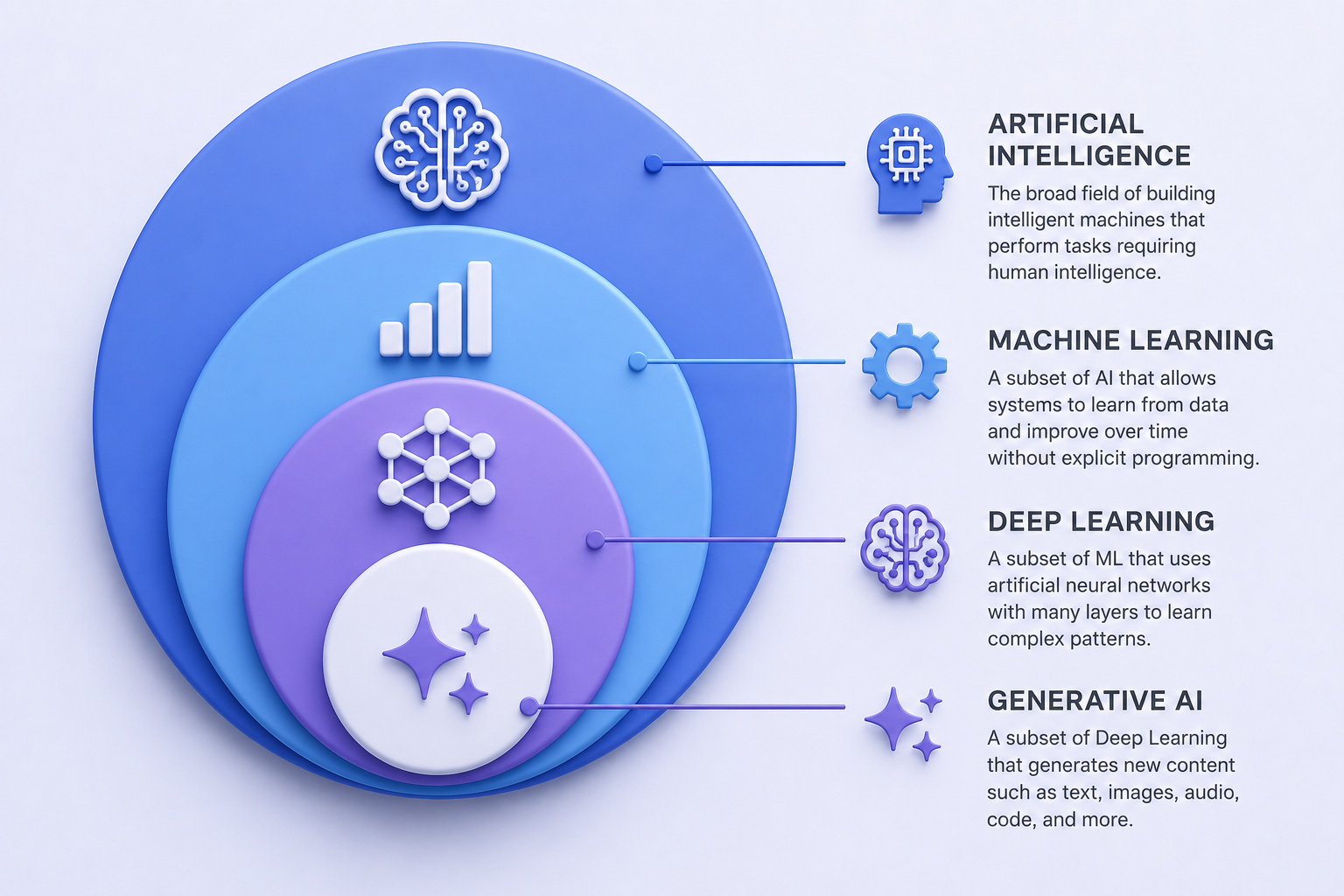
The easiest way to think about them is as a series of increasingly specialized fields.
Artificial Intelligence
│
├── Machine Learning
│     │
│     └── Deep Learning
│              │
│              └── Generative AI
Each layer builds upon the one above it. Every Generative AI system uses Deep Learning. Every Deep Learning model is a form of Machine Learning. Every Machine Learning system belongs to the broader field of Artificial Intelligence.
Let's explore each concept individually.
What Is Artificial Intelligence?
Artificial Intelligence is the broad field of computer science focused on building systems capable of performing tasks that normally require human intelligence.
These tasks include:
- Understanding language
- Solving problems
- Recognizing images
- Making predictions
- Planning actions
- Learning from data
- Assisting with decision-making
Importantly, AI is an umbrella term.
Not every AI system learns from data.
For decades, many AI systems relied on manually programmed rules rather than learning algorithms.
Artificial Intelligence simply refers to the overall goal of creating intelligent computer systems.
What Is Machine Learning?
Machine Learning (ML) is a subset of Artificial Intelligence.
Rather than programming every rule manually, developers provide data and algorithms that allow computers to discover patterns automatically.
Instead of writing:
IF email contains "Congratulations!"
AND sender is unknown
THEN spam
A machine learning system studies millions of legitimate and spam emails until it learns the patterns that distinguish one from the other.
This ability to learn from experience makes Machine Learning far more flexible than traditional rule-based software.
Today, Machine Learning powers:
- Recommendation systems
- Fraud detection
- Email spam filtering
- Medical diagnosis
- Financial forecasting
- Search engines
- Product recommendations
Machine Learning became the dominant approach to AI because many real-world problems are too complex to solve with manually written rules.
What Is Deep Learning?
Deep Learning is a specialized branch of Machine Learning.
It uses artificial neural networks, mathematical models loosely inspired by the structure of the human brain.
Unlike traditional machine learning methods, deep learning models can automatically learn increasingly complex patterns from enormous datasets.
For example, when recognizing cats in photographs:
Traditional Machine Learning often requires engineers to manually define features such as:
- Fur texture
- Ear shape
- Eye position
- Tail length
Deep Learning learns these features automatically by processing millions of examples.
This dramatically improved performance across many difficult AI tasks.
Deep Learning now powers:
- Speech recognition
- Image recognition
- Language translation
- Facial recognition
- Autonomous vehicles
- Medical imaging
- Large Language Models
The availability of massive datasets, powerful graphics processors (GPUs), and improved algorithms enabled Deep Learning to become the foundation of today's AI revolution.
What Is Generative AI?
Generative AI is a specialized application of Deep Learning.
Instead of simply recognizing or classifying information, Generative AI creates entirely new content.
Depending on the model, this content may include:
- Text
- Images
- Audio
- Video
- Software code
- Music
- 3D models
Modern Generative AI systems learn patterns from enormous collections of existing data.
When given a prompt, they generate new outputs that statistically resemble what they learned during training.
Examples include:
- Writing articles
- Answering questions
- Generating illustrations
- Creating software code
- Producing marketing content
- Summarizing documents
- Assisting researchers
Generative AI does not retrieve pre-written answers. Instead, it predicts new outputs one piece at a time based on learned patterns.
Understanding the Relationship
One of the easiest ways to understand these technologies is through a simple analogy.
Imagine transportation.
- Transportation represents Artificial Intelligence.
- Cars represent Machine Learning.
- Electric Cars represent Deep Learning.
- Self-Driving Electric Cars represent Generative AI.
Each category belongs to the one above it while becoming increasingly specialized.
Similarly:
- Artificial Intelligence includes many techniques.
- Machine Learning is one approach to AI.
- Deep Learning is one approach to Machine Learning.
- Generative AI is one application of Deep Learning.
Understanding this hierarchy removes much of the confusion surrounding modern AI terminology.
Real-World Examples
Artificial Intelligence
- Chess engines
- Rule-based expert systems
- Robotics
- Automated planning systems
Machine Learning
- Netflix recommendations
- Credit card fraud detection
- Spam filters
- Predictive maintenance
Deep Learning
- Facial recognition
- Speech recognition
- Medical image analysis
- Autonomous driving perception
Generative AI
- ChatGPT
- Claude
- Gemini
- GitHub Copilot
- Image generation models
- AI coding assistants
Each example represents a different layer within the AI ecosystem.
Why This Distinction Matters
Understanding these differences helps people evaluate AI technologies more accurately.
When a company claims to use "AI," it could mean many different things.
Some systems use simple machine learning models.
Others rely on sophisticated deep neural networks.
Still others use advanced generative models capable of producing entirely new content.
Knowing the terminology allows professionals to ask better questions, understand technical discussions, and make more informed decisions when evaluating AI products and services.
Looking Ahead
Generative AI has brought artificial intelligence into everyday life, but it represents only one part of the broader AI landscape.
Researchers continue developing new machine learning techniques, more efficient deep learning architectures, multimodal models, autonomous AI agents, and intelligent systems capable of solving increasingly complex problems.
As AI continues to evolve, understanding the relationship between these core concepts provides a strong foundation for learning every future advancement.
Key Takeaways
- Artificial Intelligence is the broad field focused on creating intelligent computer systems.
- Machine Learning is a subset of AI that enables systems to learn patterns from data.
- Deep Learning is a subset of Machine Learning that uses artificial neural networks.
- Generative AI is a specialized application of Deep Learning that creates new content.
- Every Generative AI model uses Deep Learning.
- Every Deep Learning model is a form of Machine Learning.
- Every Machine Learning system belongs to the broader field of Artificial Intelligence.
- Understanding this hierarchy makes modern AI terminology much easier to understand.
Related Articles
- What Is Artificial Intelligence? A Beginner's Guide
- How AI Models Learn: Training, Fine-Tuning, and Inference Explained
- What Are Large Language Models (LLMs)?
- Prompt Engineering Fundamentals
- Understanding AI Agents
Final Thoughts
Artificial Intelligence, Machine Learning, Deep Learning, and Generative AI are closely related, but they are not interchangeable terms. Understanding how they fit together provides one of the most important foundations in AI literacy.
As you continue learning, you'll discover that nearly every modern AI system—from recommendation engines to autonomous vehicles and conversational assistants—can be understood by tracing where it fits within this hierarchy. Once this mental model is clear, every new AI concept becomes significantly easier to understand.