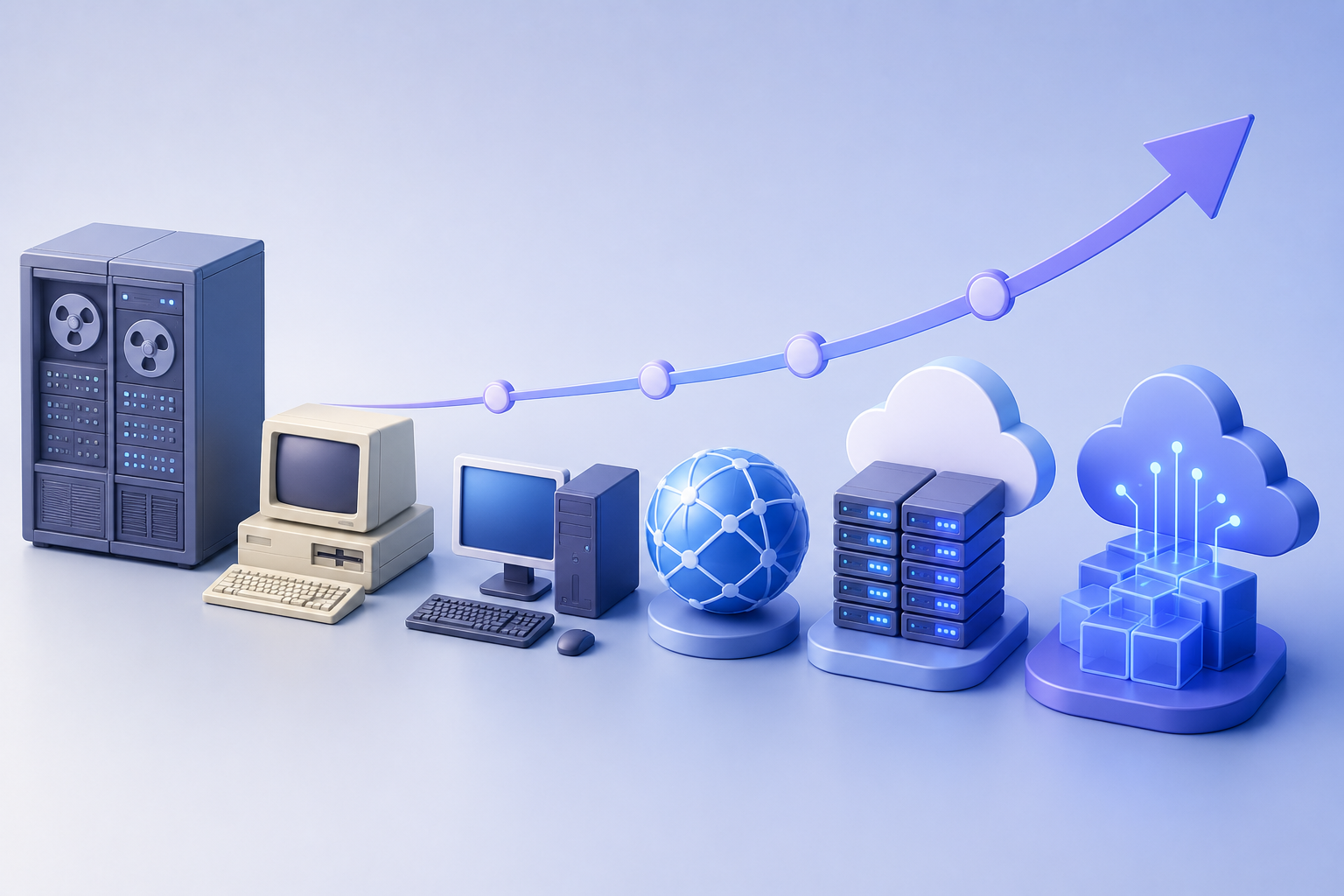
The Evolution of Computing: From Mainframes to the Cloud
Cloud Fundamentals Weekly — Issue #5
In this issue: Explore how decades of technological innovation—from room-sized mainframes to globally distributed cloud platforms—shaped the modern computing landscape.
Introduction
Cloud computing did not appear overnight.
It is the result of more than seventy years of advances in computer hardware, networking, software engineering, virtualization, and distributed systems.
Every generation of computing solved problems that the previous generation could not.
Organizations wanted computers that were smaller, faster, less expensive, easier to manage, and capable of serving more users.
The cloud represents the latest step in that evolution.
Understanding this history helps explain why cloud computing exists, why it became necessary, and why modern organizations increasingly rely on it for nearly every digital service.
The Mainframe Era (1950s–1970s)
The earliest commercial computers were enormous machines known as mainframes.
Mainframes occupied entire rooms and required specialized facilities to operate.
Only governments, universities, and large corporations could afford them.
During this period:
- Computing resources were extremely limited.
- Processing power was centralized.
- Many users shared a single computer.
- Computing time was carefully scheduled.
Although primitive by today's standards, mainframes introduced an important concept that still exists today:
Shared computing resources.
Instead of every individual owning a computer, many people accessed the same centralized system.
The Personal Computer Revolution (1970s–1990s)
As hardware became smaller and more affordable, personal computers transformed computing.
Instead of relying on centralized systems, individuals could own their own computers.
Businesses deployed desktops throughout their offices.
This revolution dramatically increased productivity, but it also created new challenges.
Organizations suddenly needed to manage:
- Hundreds of computers
- Software installations
- Hardware failures
- Data backups
- Local networks
Computing became decentralized, making IT management increasingly complex.
The Rise of Networking
As computers became common, organizations wanted them to communicate with one another.
Local Area Networks (LANs) connected computers inside offices.
Wide Area Networks (WANs) connected offices across cities and countries.
Eventually, the rapid expansion of the Internet connected millions—and later billions—of devices worldwide.
Networking transformed computers from isolated machines into connected systems capable of sharing information instantly.
Without networking, cloud computing would not exist.
The Client-Server Model
During the 1990s, organizations increasingly adopted the client-server architecture.
Instead of storing everything on individual computers:
- Servers stored shared files.
- Servers hosted databases.
- Servers managed applications.
- Employees connected using desktop computers known as clients.
This model improved collaboration and centralized important business systems.
However, organizations still needed to purchase, maintain, and expand their own server infrastructure.
As businesses grew, so did the cost and complexity of managing these systems.
The Data Center Era
As organizations required more computing power, many built dedicated data centers.
These facilities contained:
- Hundreds of servers
- Enterprise storage systems
- Networking equipment
- Backup generators
- Cooling systems
- Security infrastructure
Although data centers improved scalability, they were expensive to build and operate.
Organizations often purchased far more hardware than they normally needed because infrastructure had to support future growth and peak demand.
Much of this hardware remained underutilized most of the time.
Virtualization Changes Everything
One of the most important breakthroughs in modern computing was virtualization.
Before virtualization, a single physical server often ran only one application.
This resulted in enormous waste because servers rarely operated at full capacity.
Virtualization introduced software called a hypervisor, allowing multiple virtual machines to run on the same physical server.
Each virtual machine functioned as an independent computer.
Benefits included:
- Better hardware utilization
- Lower operational costs
- Faster deployment
- Greater flexibility
- Easier disaster recovery
Virtualization became one of the foundational technologies that made cloud computing possible.
The Birth of Cloud Computing
As virtualization matured and internet connectivity improved, technology companies recognized a new opportunity.
Instead of every organization building its own infrastructure, specialized providers could operate enormous shared data centers and rent computing resources to customers on demand.
Organizations no longer needed to:
- Purchase servers
- Build data centers
- Install networking equipment
- Maintain hardware
- Replace aging infrastructure
Instead, they could simply request computing resources whenever needed.
Cloud computing fundamentally shifted infrastructure from an ownership model to a service model.
Modern Cloud Platforms
Today's cloud providers operate globally distributed infrastructure consisting of:
- Millions of servers
- High-speed networking
- Massive storage systems
- Artificial intelligence infrastructure
- Advanced cybersecurity systems
- Automated monitoring
- Global content delivery networks
Customers can deploy applications within minutes while scaling resources across multiple geographic regions.
What once required months of planning can now be accomplished in minutes.
The Next Stage of Computing
Cloud computing continues to evolve.
Modern innovations include:
- Containers
- Kubernetes
- Serverless computing
- Edge computing
- Artificial intelligence infrastructure
- Quantum computing research
- Autonomous infrastructure management
Rather than replacing cloud computing, these technologies extend its capabilities and allow organizations to build increasingly sophisticated systems.
The cloud remains the foundation that supports many of these emerging technologies.
Common Misconceptions
"Cloud computing replaced traditional data centers."
Many organizations still operate private data centers.
Cloud computing expanded infrastructure options rather than eliminating previous technologies.
"Older computing technologies are obsolete."
Mainframes, client-server systems, and private data centers continue to support many critical industries today.
Modern cloud architectures often integrate with existing infrastructure.
"Cloud computing was invented by one company."
Cloud computing emerged gradually through decades of innovations contributed by researchers, universities, hardware manufacturers, software companies, and cloud providers.
It represents the evolution of many technologies rather than a single invention.
Why This Matters
Understanding the history of computing provides valuable context for modern cloud architecture.
Every stage of computing solved challenges created by the previous generation.
Mainframes introduced shared computing.
Personal computers increased accessibility.
Networking connected systems.
Virtualization improved efficiency.
Cloud computing combined these innovations into a flexible, scalable, globally accessible platform.
As cloud technology continues evolving, these foundational concepts remain essential for understanding where computing is headed next.
Key Takeaways
- Cloud computing is the result of decades of technological evolution.
- Mainframes introduced centralized shared computing.
- Personal computers decentralized computing.
- Networking connected computers worldwide.
- Client-server architecture centralized business applications.
- Virtualization dramatically improved hardware efficiency.
- Cloud computing transformed infrastructure into an on-demand service.
- Modern cloud platforms continue evolving alongside AI, automation, and distributed systems.
Looking Ahead
One technology made cloud computing economically practical by allowing multiple virtual computers to share the same physical hardware.
In the next issue, we'll explore:
Virtualization and Containers Explained
You'll learn how virtualization works, why containers became so popular, how they differ, and why both technologies are fundamental to modern cloud computing.