What Is Medical Artificial Intelligence?
Issue #2 · Medical AI
Introduction
Artificial intelligence (AI) is rapidly becoming one of the most influential technologies in modern healthcare. From helping radiologists analyze medical images to assisting researchers in discovering new medicines, AI is transforming how healthcare professionals work.
Despite its growing importance, AI does not replace doctors or make healthcare entirely automated. Instead, it serves as a powerful tool that helps clinicians process information, recognize patterns, and make more informed decisions.
Understanding what medical AI is—and what it is not—is essential for anyone interested in the future of healthcare technology.
What Is Artificial Intelligence?
Artificial intelligence refers to computer systems that can perform tasks that normally require human intelligence.
These tasks include:
- Recognizing patterns
- Learning from data
- Understanding language
- Identifying objects in images
- Making predictions
- Supporting decision-making
Rather than following only fixed instructions, many AI systems improve by learning from large amounts of data.
What Makes Medical AI Different?
Medical AI applies these same technologies specifically to healthcare.
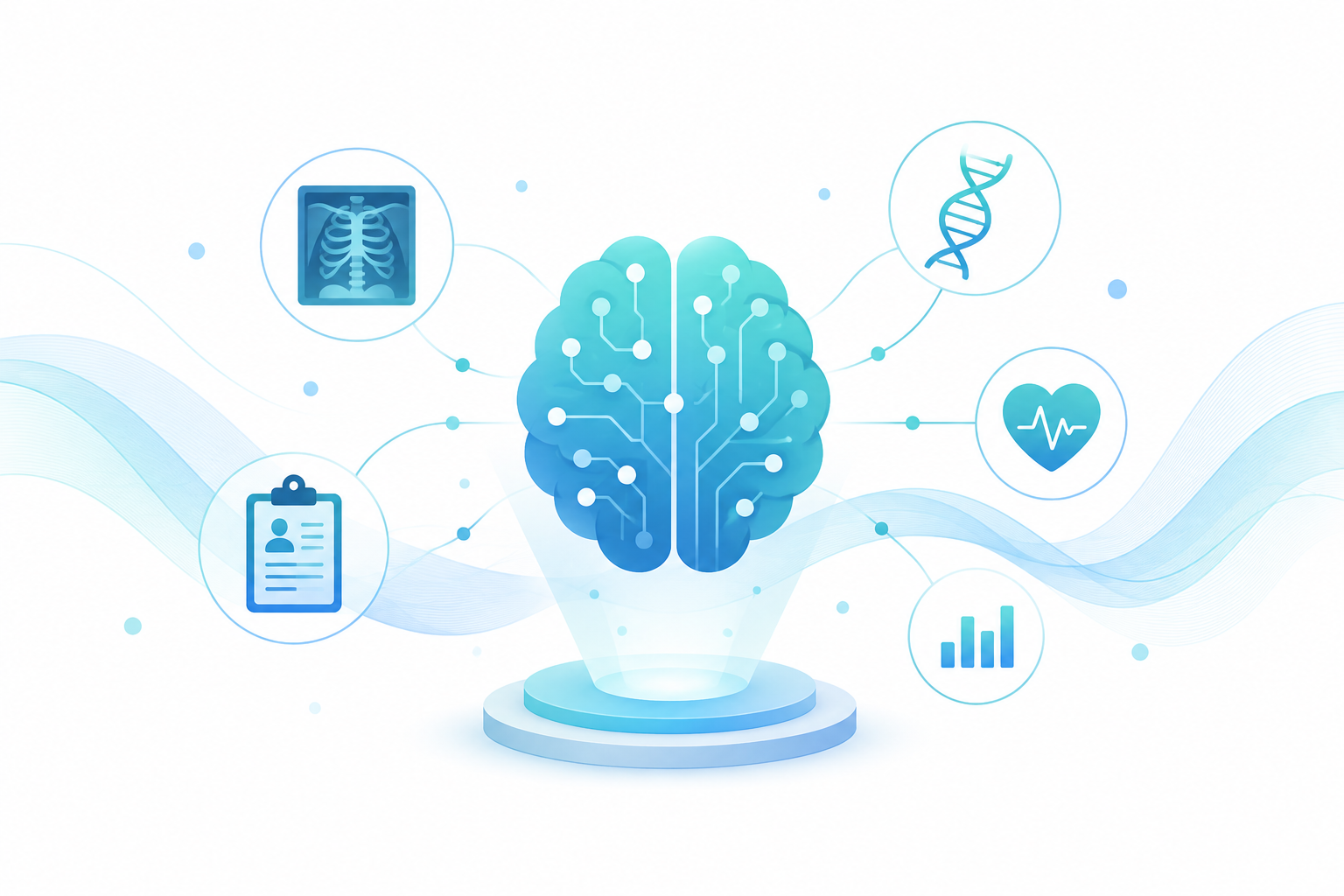
Instead of learning from photographs of everyday objects or internet search data, medical AI learns from healthcare-related information such as:
- Medical images
- Laboratory results
- Electronic health records
- Clinical notes
- Medical research
- Physiological signals from wearable devices
Its purpose is to assist healthcare professionals by providing insights that may improve efficiency, accuracy, and consistency.
How Does Medical AI Learn?
Most modern AI systems are built using machine learning.
Machine learning allows computers to identify patterns within large datasets.
For example, an AI system may be trained using hundreds of thousands of chest X-rays.
Over time, it learns to recognize visual patterns associated with different medical conditions.
Once trained, the system can analyze new images and identify areas that deserve closer attention by a clinician.
The AI is not "thinking" like a human. Instead, it is identifying statistical patterns it has learned from previous examples.
Common Applications of Medical AI
Medical AI is already being used in many areas of healthcare.
Medical Imaging
AI can assist radiologists by analyzing:
- X-rays
- CT scans
- MRI scans
- Mammograms
- Ultrasound images
These systems can highlight areas that may require further review, helping clinicians work more efficiently.
Clinical Documentation
Healthcare professionals spend significant time documenting patient visits.
AI-powered documentation tools can:
- Summarize conversations
- Generate clinical notes
- Organize medical records
- Reduce administrative workload
This allows clinicians to spend more time focusing on patient care.
Predictive Analytics
AI can analyze historical healthcare data to identify patterns that may indicate future risks.
Examples include:
- Predicting hospital readmissions
- Identifying patients at higher risk for complications
- Detecting early signs of disease progression
These predictions help healthcare teams prioritize care and allocate resources more effectively.
Drug Discovery
Developing new medicines traditionally requires many years of research.
AI can accelerate portions of this process by:
- Analyzing biological data
- Identifying promising drug candidates
- Predicting molecular interactions
- Supporting scientific research
While laboratory testing and clinical trials remain essential, AI helps researchers explore possibilities more efficiently.
Remote Patient Monitoring
Wearable devices continuously collect health information such as:
- Heart rate
- Physical activity
- Sleep patterns
- Blood oxygen levels
AI can analyze these streams of data and identify unusual trends that healthcare professionals may wish to investigate further.
Benefits of Medical AI
When used responsibly, medical AI offers several advantages.
These include:
- Faster analysis of large datasets
- Improved consistency
- Assistance with repetitive tasks
- Earlier identification of important patterns
- Increased efficiency for healthcare professionals
- Support for medical research
Importantly, AI is designed to augment human expertise rather than replace it.
Challenges and Limitations
Although medical AI is powerful, it also has limitations.
AI systems depend on the quality of the data they are trained on.
Poor-quality or biased data can lead to inaccurate results.
Healthcare organizations must also address important issues such as:
- Patient privacy
- Data security
- Transparency
- Regulatory approval
- Clinical validation
- Human oversight
Because of these challenges, AI recommendations are typically reviewed by qualified healthcare professionals before important decisions are made.
The Future of Medical AI
Medical AI continues to advance rapidly.
Future systems may become better at:
- Assisting with diagnosis
- Personalizing healthcare
- Supporting clinicians during patient visits
- Accelerating biomedical research
- Improving hospital operations
Rather than replacing healthcare professionals, AI will likely become another essential tool alongside medical knowledge, clinical experience, and modern medical equipment.
Key Takeaways
- Medical AI applies artificial intelligence to healthcare.
- Most medical AI systems learn patterns from large healthcare datasets.
- AI assists with medical imaging, documentation, research, and predictive analytics.
- AI supports healthcare professionals rather than replacing them.
- Responsible use requires high-quality data, privacy protections, and human oversight.
- Medical AI is becoming a foundational technology across modern healthcare.
Looking Ahead
In the next issue, we'll explore another cornerstone of digital healthcare:
Understanding Electronic Health Records (EHRs)
We'll examine how healthcare organizations manage patient information digitally and why electronic health records form the backbone of modern healthcare systems.
Final Thoughts
Artificial intelligence is becoming an integral part of modern healthcare. Its greatest value lies not in replacing clinicians, but in helping them work more efficiently, uncover meaningful insights, and make better-informed decisions.
As healthcare continues to evolve, understanding the principles behind medical AI will be far more valuable than simply knowing today's tools. The technology will change, but the foundational concepts will remain essential for years to come.
Thank you for reading.
I'll see you in the next issue.