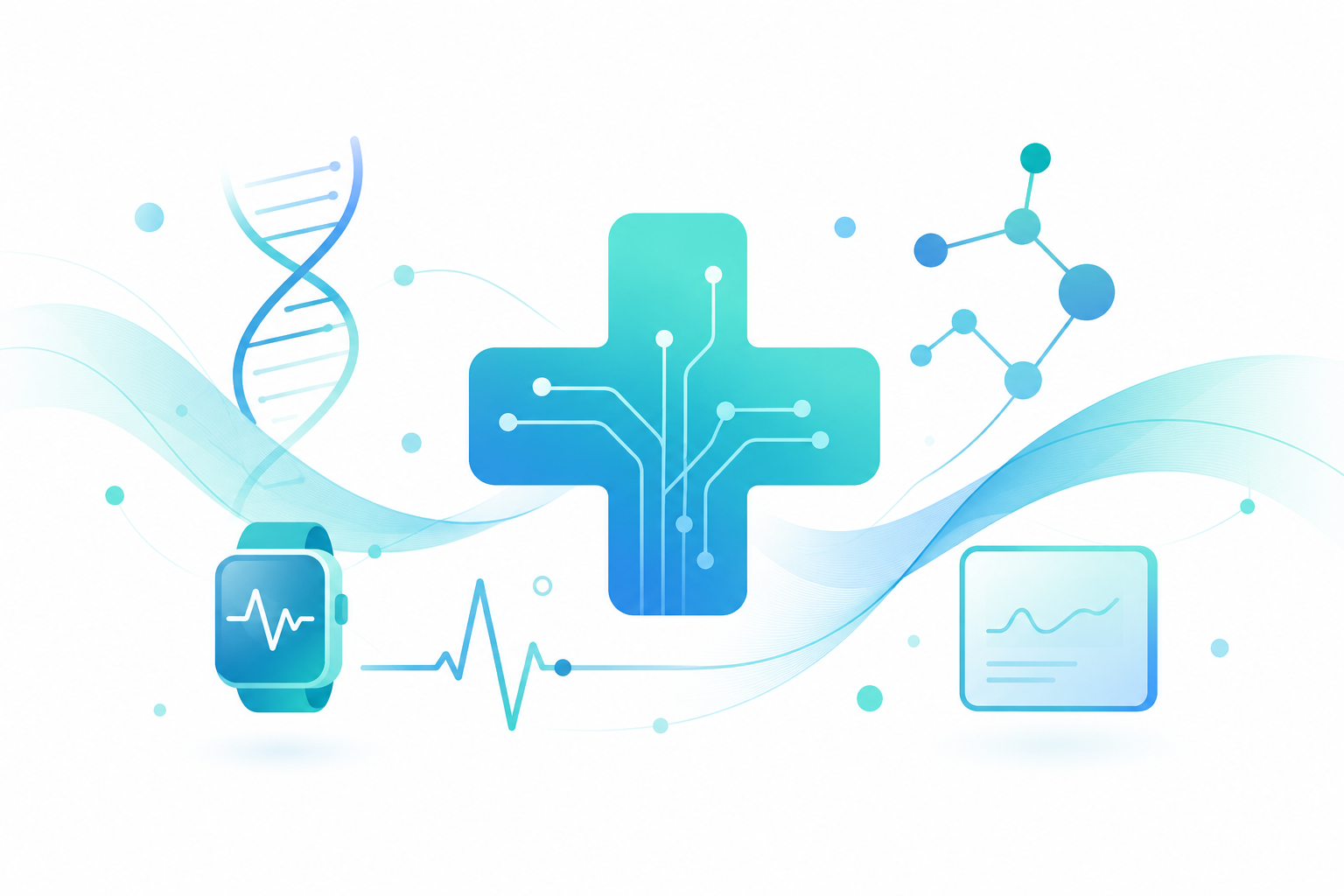
How Technology Is Transforming Modern Healthcare
Issue #1 · Medical Technology Fundamentals
Introduction
Healthcare has always relied on innovation. From the invention of the stethoscope to the development of MRI scanners, new technologies have continually improved how diseases are detected, treated, and prevented.
Today, healthcare is entering another major transformation. Artificial intelligence can assist clinicians in analyzing medical images. Wearable devices can monitor heart rate around the clock. Robots help surgeons perform delicate procedures, while cloud computing allows healthcare professionals to securely access patient information from almost anywhere.
Although these technologies are different, they all share the same goal: improving healthcare by helping medical professionals make better decisions, increasing efficiency, and delivering better outcomes for patients.
Understanding these technologies is becoming increasingly valuable—not only for healthcare professionals, but also for engineers, researchers, business leaders, policymakers, and anyone interested in the future of medicine.
What Is Healthcare Technology?
Healthcare technology refers to the tools, systems, software, and equipment used to improve the delivery of healthcare.
Rather than replacing doctors or nurses, technology is designed to support them by providing better information, automating repetitive tasks, and enabling new ways to diagnose, monitor, and manage health.
Healthcare technology spans many different fields, including software engineering, biomedical engineering, data science, artificial intelligence, cloud computing, robotics, biotechnology, and cybersecurity.
Together, these disciplines form the foundation of modern digital healthcare.
Why Healthcare Is Becoming More Digital
Healthcare has traditionally relied on paper records, manual processes, and in-person visits.
As populations grow and healthcare becomes more complex, digital technologies help organizations manage increasing amounts of information while improving accessibility and efficiency.
Several factors are driving this transformation:
- Growing amounts of medical data
- Aging populations
- Increased demand for healthcare services
- Advances in computing power
- Faster internet connectivity
- Improvements in sensors and wearable devices
- Progress in artificial intelligence and machine learning
These developments allow healthcare providers to deliver care more efficiently while giving patients greater access to information about their own health.
The Four Major Pillars of Modern Healthcare Technology
This newsletter focuses on four core areas that are shaping the future of healthcare.
Medical Artificial Intelligence
Medical AI uses computer systems to analyze healthcare data and assist with clinical decision-making.
Examples include:
- Detecting patterns in medical images
- Assisting with documentation
- Predicting potential health risks
- Supporting clinical workflows
- Accelerating medical research
AI is designed to assist healthcare professionals—not replace their expertise.
Digital Health
Digital health focuses on using software and connected technologies to improve healthcare delivery.
Examples include:
- Electronic health records
- Telemedicine platforms
- Mobile health applications
- Wearable fitness and health devices
- Remote patient monitoring
Digital health helps connect patients, clinicians, and healthcare organizations more effectively.
Medical Technology
Medical technology includes the physical devices and equipment used throughout healthcare.
Examples include:
- MRI scanners
- CT scanners
- Ultrasound machines
- Surgical robots
- Infusion pumps
- Laboratory equipment
- Patient monitoring systems
These technologies provide healthcare professionals with information and capabilities that would otherwise be impossible.
Biotechnology
Biotechnology combines biology with technology to better understand living systems.
Examples include:
- DNA sequencing
- Vaccine development
- Gene editing
- Biopharmaceuticals
- Synthetic biology
- Cell-based therapies
Biotechnology is one of the fastest-growing fields in healthcare and continues to expand our understanding of human biology.
How These Technologies Work Together
One of the most exciting aspects of modern healthcare is that these technologies rarely operate independently.
Imagine a patient wearing a smartwatch that continuously monitors heart activity.
The wearable device collects health data throughout the day.
That information is securely transmitted to cloud-based systems.
Artificial intelligence analyzes the incoming data for unusual patterns.
If something appears abnormal, healthcare professionals can review the information and determine whether further evaluation is needed.
In this example, multiple technologies work together:
- Wearable sensors
- Cloud computing
- Artificial intelligence
- Medical software
- Healthcare professionals
This integration is becoming increasingly common across modern healthcare.
Why Understanding Healthcare Technology Matters
Healthcare technology affects nearly everyone.
Whether scheduling appointments online, reviewing laboratory results through a patient portal, participating in a virtual appointment, or using a fitness tracker, technology is becoming part of everyday healthcare.
Beyond patients, demand for healthcare technology continues to grow across many careers, including:
- Software engineering
- Artificial intelligence
- Biomedical engineering
- Cybersecurity
- Data science
- Product management
- Healthcare administration
- Clinical research
Understanding how these technologies work creates opportunities across both healthcare and technology industries.
Key Takeaways
- Healthcare technology combines medicine with engineering, software, and science.
- Modern healthcare is becoming increasingly digital.
- Artificial intelligence supports healthcare professionals by analyzing complex data.
- Digital health improves communication and access to healthcare services.
- Medical technology includes the devices used to diagnose, monitor, and treat patients.
- Biotechnology applies biological science to develop new medical innovations.
- Together, these technologies are transforming how healthcare is delivered around the world.
Looking Ahead
In the next issue, we'll explore one of the fastest-growing areas of healthcare technology:
What Is Medical Artificial Intelligence?
We'll explain how AI works in healthcare, where it's already being used today, and why understanding its capabilities—and its limitations—is essential for anyone interested in the future of medicine.
Final Thoughts
Healthcare is undergoing one of the most significant technological transformations in history. Advances in artificial intelligence, digital health, medical devices, and biotechnology are reshaping how healthcare is delivered, researched, and improved.
The best way to understand this rapidly evolving field is not by focusing on individual products or headlines, but by learning the foundational technologies that make modern healthcare possible. Those principles will remain valuable long after today's tools have evolved.
Thank you for reading.
I'll see you in the next issue.