The Evolution of Trust: Why Blockchain Was Invented
Blockchain Fundamentals Weekly — Issue #2
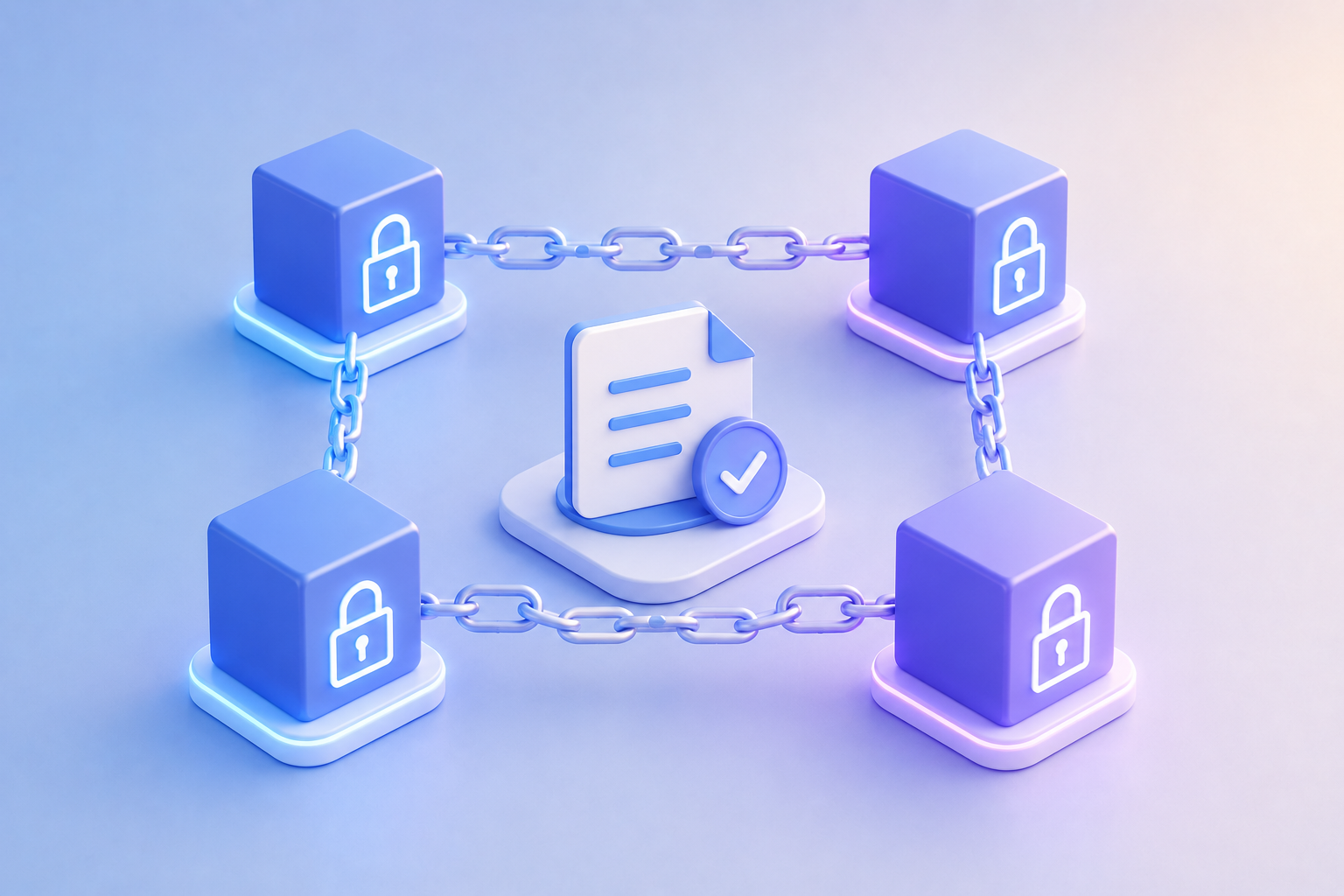
In our first issue, we learned that a blockchain is a distributed digital ledger maintained by many computers instead of a single central authority.
But that raises an important question.
Why was blockchain invented in the first place?
What problem was so significant that researchers and engineers spent decades developing an entirely new way to store and verify information?
To answer that question, we need to look far beyond computers.
We need to look at the history of human trust.
Understanding blockchain is not simply about understanding technology—it is about understanding how societies have coordinated, exchanged value, and built trust throughout history.
Why Trust Matters
Every society depends on trust.
Without trust, everyday activities become incredibly difficult.
Consider a few common examples:
- Sending money to someone
- Buying a home
- Signing a business contract
- Receiving medical treatment
- Voting in an election
- Purchasing products online
Each of these activities requires confidence that records are accurate and that agreements will be honored.
Trust is the invisible infrastructure that allows modern economies to function.
The question is not whether trust exists.
The question is who—or what—we trust.
Trust Before Institutions
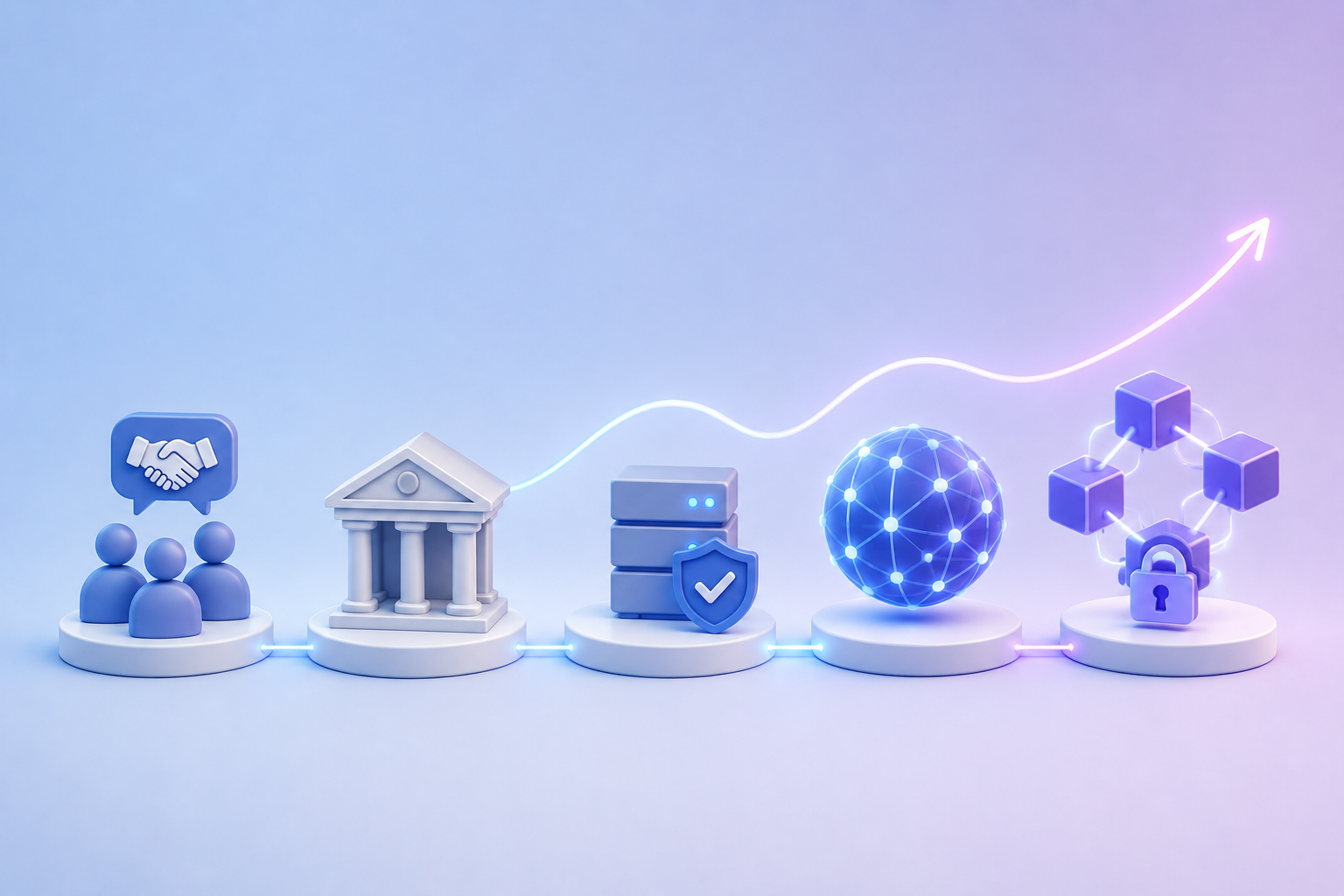
Thousands of years ago, trust was personal.
People lived in small communities where everyone knew one another.
If someone borrowed food, broke a promise, or failed to repay a debt, the entire community would know.
Reputation acted as the enforcement mechanism.
This worked well because communities were small.
However, as civilizations grew, personal relationships were no longer enough.
People increasingly traded with strangers.
New systems of trust became necessary.
The Rise of Trusted Institutions
As societies expanded, trusted intermediaries emerged to solve coordination problems.
Instead of relying on personal reputation alone, people began trusting institutions.
Examples include:
- Banks to safeguard money
- Governments to maintain property records
- Courts to enforce contracts
- Businesses to manage customer accounts
- Universities to verify academic credentials
These organizations became central authorities responsible for maintaining important records.
This model has powered civilization for centuries.
It remains highly effective today.
The Digital Age Introduced New Challenges
The internet transformed how information moves around the world.
Messages that once took weeks could suddenly travel in seconds.
Documents became digital.
Photos became digital.
Music became digital.
Money also became increasingly digital.
However, digital information behaves differently from physical objects.
A digital file can be copied perfectly and instantly.
If digital money behaved the same way, anyone could duplicate it endlessly.
Clearly, that would be disastrous.
This challenge became known as the double-spending problem.
The Double-Spending Problem
Imagine you own one digital coin.
Without safeguards, you could attempt to send that same coin to two different people at nearly the same time.
If both recipients accepted the payment, the same asset would effectively exist twice.
Physical cash avoids this problem naturally.
Once you hand someone a twenty-dollar bill, you no longer possess it.
Digital assets require another method to ensure ownership changes correctly.
For decades, banks solved this problem by maintaining a central ledger.
When money moves between accounts, the bank updates its records.
Everyone trusts the bank's version of the truth.
Centralized Trust Works—But Has Limitations
Centralized systems have enabled enormous economic growth.
They are fast, familiar, and efficient.
However, every centralized system also introduces trade-offs.
For example:
- A single database can fail.
- A central organization controls access.
- Records depend on one administrator's integrity.
- Services may become unavailable during outages.
- Users must trust the institution to protect their information.
These limitations do not mean centralized systems are bad.
Rather, they highlight why researchers began exploring alternative approaches.
A New Question
For decades, computer scientists asked an important question.
Could a network of independent computers agree on a shared record without relying on a central authority?
This problem became one of the most significant challenges in distributed computing.
The solution would require answering difficult questions such as:
- How do participants know which transactions are valid?
- How can everyone agree on the same version of history?
- How do you prevent malicious participants from cheating?
- How do you ensure old records cannot easily be altered?
Finding answers would take decades of research in cryptography, networking, distributed systems, and computer science.
Blockchain's Breakthrough
Blockchain did not eliminate trust.
Instead, it changed where trust is placed.
Rather than trusting a single institution, participants trust:
- Mathematical algorithms
- Cryptographic security
- Consensus mechanisms
- Transparent protocol rules
- Independent verification by the network
Instead of asking one organization,
"Can we trust you?"
participants ask,
"Can we trust the system?"
This shift is one of blockchain's most significant innovations.
Trust Through Verification
One of blockchain's guiding principles is often summarized as:
Don't trust. Verify.
Traditional systems frequently require users to trust an intermediary's records.
Blockchain encourages independent verification.
Because many participants maintain copies of the ledger, anyone can compare records and confirm that they agree.
Verification replaces blind trust.
This idea has influenced many areas of modern distributed systems beyond blockchain itself.
Why Blockchain Was Revolutionary
Blockchain did not invent cryptography.
It did not invent networking.
It did not invent distributed databases.
Instead, blockchain combined existing technologies into a system capable of maintaining a shared history without a central owner.
That combination represented a major milestone in computer science.
For the first time, large networks of participants could coordinate around a common ledger using transparent rules rather than relying entirely on centralized control.
Beyond Cryptocurrency
Although blockchain first gained global attention through Bitcoin, its underlying ideas extend much further.
Today, researchers and organizations explore blockchain for:
- Supply chain transparency
- Digital identity
- Healthcare record sharing
- Trade finance
- Intellectual property
- Cross-border payments
- Government registries
- Academic credentials
- Asset tokenization
- Secure audit trails
Not every use case requires blockchain.
But every serious discussion begins by understanding the problem blockchain was designed to solve: establishing trust in distributed environments.
Centralization vs. Decentralization
It is important to understand that blockchain is not trying to replace every centralized system.
Centralized systems remain the best choice for many applications because they are often simpler, faster, and easier to manage.
Blockchain is most valuable when multiple parties need to cooperate but no single participant should control the entire system.
The key question is not:
"Is blockchain better?"
The better question is:
"Is decentralized trust appropriate for this problem?"
Good engineers choose technologies based on requirements—not hype.
Why This Matters
Trust has always been essential to civilization.
Throughout history, humans have developed increasingly sophisticated ways to establish confidence between strangers.
Blockchain represents the latest chapter in that evolution.
Rather than depending entirely on centralized institutions, blockchain demonstrates that trust can also emerge from carefully designed protocols, cryptography, and distributed consensus.
Whether blockchain ultimately transforms every industry remains uncertain.
What is certain is that it has fundamentally changed how computer scientists, engineers, economists, and policymakers think about trust in the digital age.
Understanding that shift is the foundation for understanding everything that follows.
Key Takeaways
- Human societies have always depended on systems of trust.
- Early trust relied on personal relationships and reputation.
- Larger societies introduced trusted institutions such as banks and governments.
- Digital information created new challenges, including the double-spending problem.
- Traditional digital systems solve these problems through centralized authorities.
- Blockchain shifts trust from institutions toward cryptography, consensus, and distributed verification.
- Blockchain is not about eliminating trust—it is about changing how trust is established.
- Understanding the evolution of trust provides the context needed to understand blockchain technology.
Looking Ahead
In our next issue, we'll examine Understanding Blocks, Transactions, and the Blockchain Ledger. We'll explore how information is organized inside a blockchain, what actually happens during a transaction, and how blocks are linked together to create an auditable, tamper-resistant history.