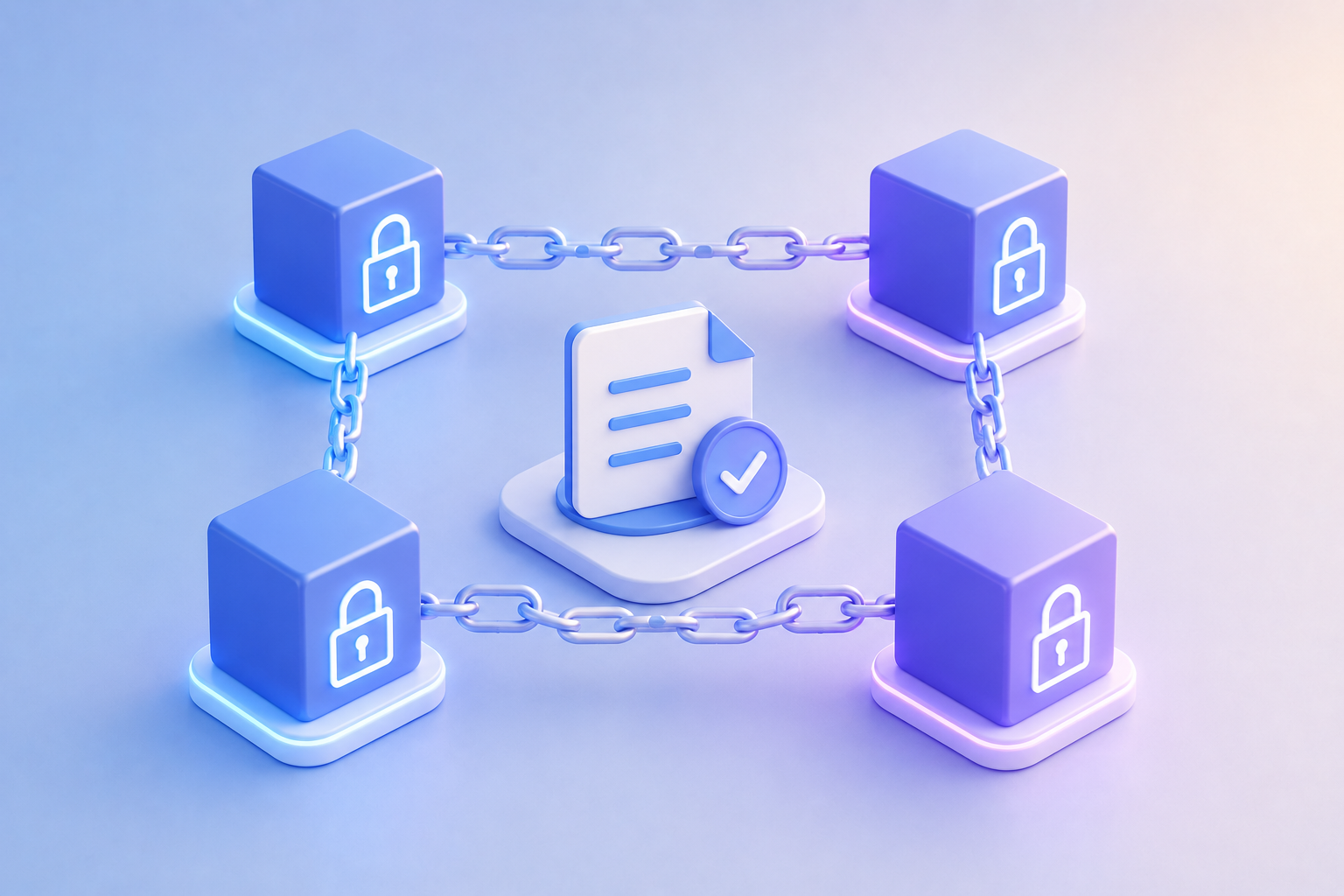
What Is Blockchain? A Beginner's Guide to Distributed Ledger Technology
Blockchain Fundamentals Weekly — Issue #1
Welcome to the first issue of Blockchain Fundamentals Weekly.
If you've heard terms like Bitcoin, Ethereum, Web3, or smart contracts, you've almost certainly heard the word blockchain. Yet despite its popularity, blockchain remains one of the most misunderstood technologies of the modern era.
Many people believe blockchain is simply another word for cryptocurrency. Others assume it's a technology used only by financial institutions or speculative investors.
Neither is true.
Blockchain is fundamentally a new way of storing, verifying, and sharing information across many computers without relying on a single trusted authority.
Whether you're a business professional, developer, cybersecurity practitioner, student, or simply curious about emerging technologies, understanding blockchain begins with understanding this core idea.
In this article, we'll build that foundation.
What Is a Blockchain?
A blockchain is a distributed digital ledger.
Let's break that definition into simpler pieces.
A ledger is simply a record of information.
For thousands of years, humans have used ledgers to record:
- Financial transactions
- Property ownership
- Business agreements
- Inventory
- Identity records
Traditionally, one organization owns and maintains the ledger.
Examples include:
- Banks
- Governments
- Hospitals
- Universities
- Businesses
Blockchain introduces a different model.
Instead of one organization maintaining the ledger, many independent computers maintain identical copies simultaneously.
Every participant agrees on the current state of the ledger through carefully designed rules.
This creates a shared source of truth.
Why Was Blockchain Created?
To understand blockchain, it's helpful to understand the problem it was designed to solve.
Imagine sending a digital file.
If you email someone a photo, your computer doesn't lose the original copy.
It simply creates another one.
Digital information is incredibly easy to duplicate.
Money, however, cannot work this way.
If digital money could be copied endlessly, anyone could create unlimited wealth.
This challenge is known as the double-spending problem.
Before blockchain, preventing double spending required a trusted intermediary.
For example:
- Banks verify payments.
- Credit card companies authorize purchases.
- Payment processors maintain account balances.
Blockchain introduced a different approach.
Instead of trusting one central organization, the network itself verifies every transaction.
Trust shifts from institutions to mathematics, cryptography, and distributed consensus.
Understanding the "Chain"
The word blockchain comes from two concepts.
Blocks
Information is grouped together into collections called blocks.
A block typically contains:
- A list of verified transactions
- A timestamp
- A unique cryptographic fingerprint
- A reference to the previous block
Think of a block as a page in a permanent accounting book.
Once that page is finalized, a new page begins.
Chains
Each block references the block before it.
This creates an unbroken sequence.
Block 1 → Block 2 → Block 3 → Block 4 → Block 5
Because every block depends on the previous one, changing old information would require changing every block that follows it.
This structure makes unauthorized modifications extremely difficult.
What Makes Blockchain Different?
Blockchain combines several technologies that already existed.
Its innovation comes from how these technologies work together.
The most important characteristics include:
1. Decentralization
Traditional systems usually have one central database.
Blockchain distributes copies of the ledger across many computers called nodes.
Instead of asking one computer what happened, many computers agree together.
This removes a single point of failure.
2. Transparency
Many public blockchains allow anyone to inspect the transaction history.
Although identities are often represented by cryptographic addresses rather than names, the ledger itself is publicly visible.
This transparency allows anyone to independently verify historical records.
3. Immutability
Blockchain data is designed to be extremely difficult to alter after it has been confirmed.
This does not mean blockchain data is magically impossible to change.
Instead, changing confirmed records would require enormous computational effort and widespread agreement across the network, making unauthorized changes impractical on well-secured blockchains.
4. Distributed Trust
Perhaps blockchain's greatest innovation is distributed trust.
Instead of trusting one company or government, participants trust:
- Cryptography
- Consensus rules
- Open protocols
- Independent verification
Trust becomes a property of the system rather than a single organization.
How Does a Blockchain Work? (High-Level Overview)
Although blockchain systems can be highly complex, the overall process is surprisingly straightforward.
Imagine Alice wants to send digital assets to Bob.
The process looks like this:
Step 1
Alice creates a transaction.
Step 2
The transaction is broadcast to the blockchain network.
Step 3
Network participants verify that the transaction follows all protocol rules.
Step 4
Verified transactions are grouped into a new block.
Step 5
The new block is added to the blockchain.
Step 6
Every participant updates their copy of the ledger.
Now the entire network agrees on the new state.
Blockchain Is More Than Cryptocurrency
One of the biggest misconceptions is that blockchain exists only for cryptocurrencies.
Cryptocurrency is simply one application.
Blockchain technology can also support:
- Supply chain tracking
- Digital identity
- Healthcare records
- Asset tokenization
- Voting systems
- Cross-border payments
- Intellectual property management
- Document verification
- Insurance processing
- Government record keeping
Different industries adopt blockchain for different reasons, but they all benefit from the same core properties:
- Shared records
- Strong integrity
- Distributed verification
- Reduced reliance on intermediaries
Public vs Private Blockchains
Not every blockchain works the same way.
Broadly speaking, there are two common models.
Public Blockchains
Anyone can:
- Join
- Read data
- Submit transactions
- Participate according to the network's rules
Examples include Bitcoin and Ethereum.
Private Blockchains
Participation is controlled by an organization or consortium.
Only approved members may:
- Access the network
- Validate transactions
- Maintain the ledger
Private blockchains are common in enterprise environments where confidentiality and governance are important.
We'll explore these models in much greater detail in a future article.
Common Misconceptions
As blockchain has become more popular, several myths have emerged.
Myth 1
Blockchain and Bitcoin are the same thing.
Reality:
Bitcoin is one application built using blockchain technology.
Myth 2
Blockchain is completely anonymous.
Reality:
Many public blockchains are pseudonymous rather than anonymous.
Transactions remain publicly visible.
Myth 3
Blockchain can never be hacked.
Reality:
Blockchain networks are highly secure by design, but applications, wallets, exchanges, and poorly implemented systems can still be compromised.
Myth 4
Every business needs blockchain.
Reality:
Blockchain is a powerful tool, but it is not the right solution for every problem.
Good engineering starts with selecting the appropriate technology for the problem—not forcing a technology where it doesn't belong.
Why Blockchain Matters
Blockchain represents more than a new database.
It introduces a new way for people, businesses, and organizations to coordinate without relying entirely on centralized intermediaries.
For decades, digital systems have largely depended on trusted institutions to maintain records and verify transactions.
Blockchain explores an alternative model—one where verification is distributed across a network and governed by transparent rules.
Whether blockchain ultimately transforms every industry remains to be seen.
What is already clear is that it has fundamentally changed how technologists think about trust, ownership, digital assets, and decentralized systems.
Understanding blockchain today is increasingly becoming part of digital literacy for professionals across technology, finance, cybersecurity, healthcare, supply chain, and government.
Key Takeaways
- Blockchain is a distributed digital ledger shared across many computers.
- It enables multiple participants to maintain a common record without relying on a single central authority.
- Information is stored in blocks that are cryptographically linked together.
- Blockchain combines decentralization, cryptography, and consensus to establish trust.
- Cryptocurrency is only one application of blockchain technology.
- Public and private blockchains serve different purposes and use cases.
- Blockchain is not a solution for every problem, but it is an important innovation in distributed systems.
- Understanding blockchain begins with understanding how trust can be established through technology rather than centralized control.
Looking Ahead
In our next issue, we'll explore The Evolution of Trust: Why Blockchain Was Invented, where we'll examine how societies have historically established trust, why centralized systems became necessary, and how blockchain introduced a fundamentally different model for coordinating information across the internet.
Every expert in blockchain starts with the fundamentals—and that's exactly where we're headed.