Understanding Orbits: How Spacecraft Stay in Space
Space Fundamentals Weekly — Issue #2
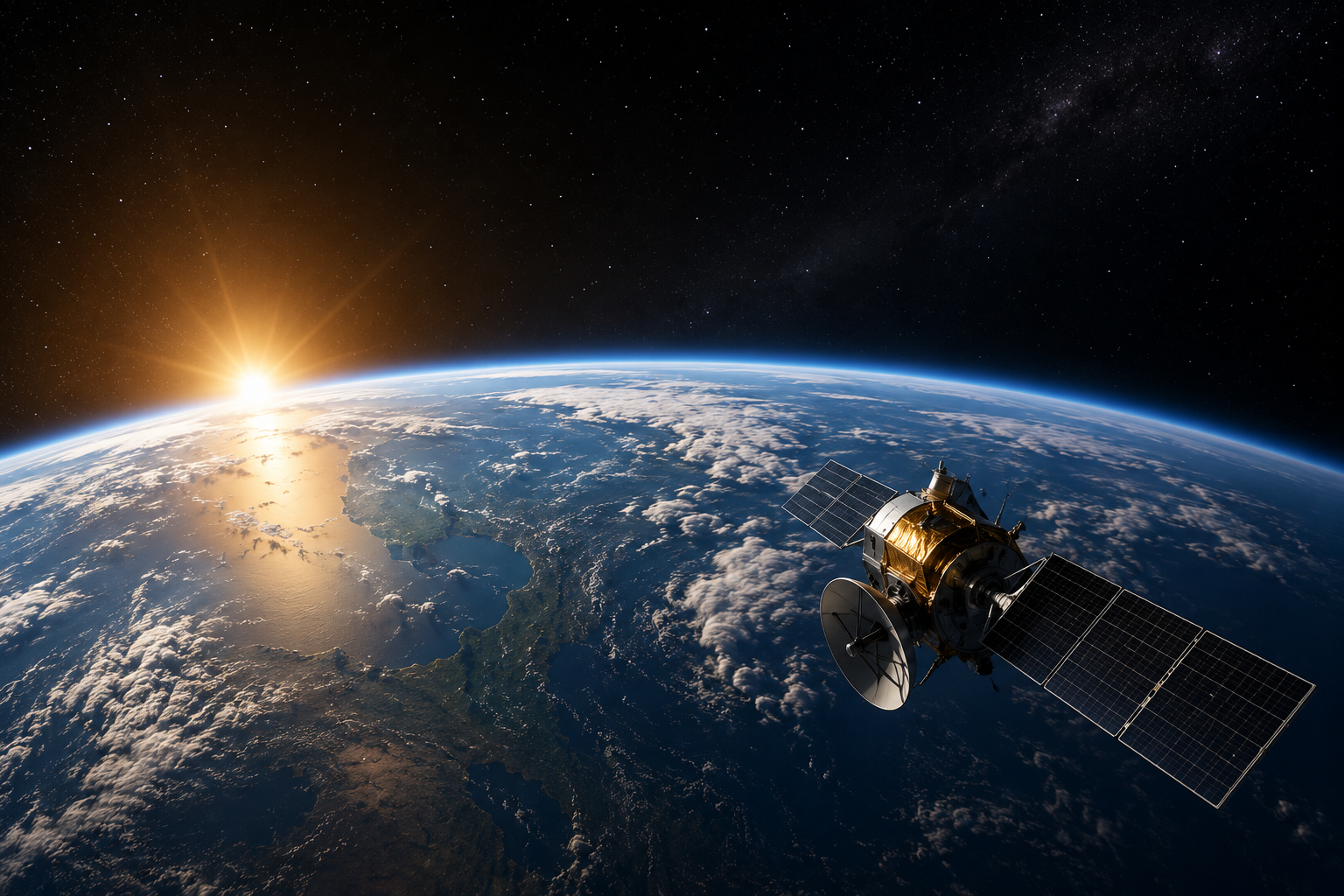
When we look at photographs of Earth from space, one question naturally comes to mind:
Why don't satellites simply fall back to Earth?
After all, Earth's gravity is constantly pulling on every object nearby.
The answer lies in one of the most important concepts in spaceflight: orbit.
Understanding orbits is the foundation of modern space exploration. Every satellite, the International Space Station, the Moon, and even planets orbit because of the same fundamental laws of physics.
In this issue, we'll explore what an orbit is, why spacecraft stay in space, and how engineers use different types of orbits to accomplish different missions.
What Is an Orbit?
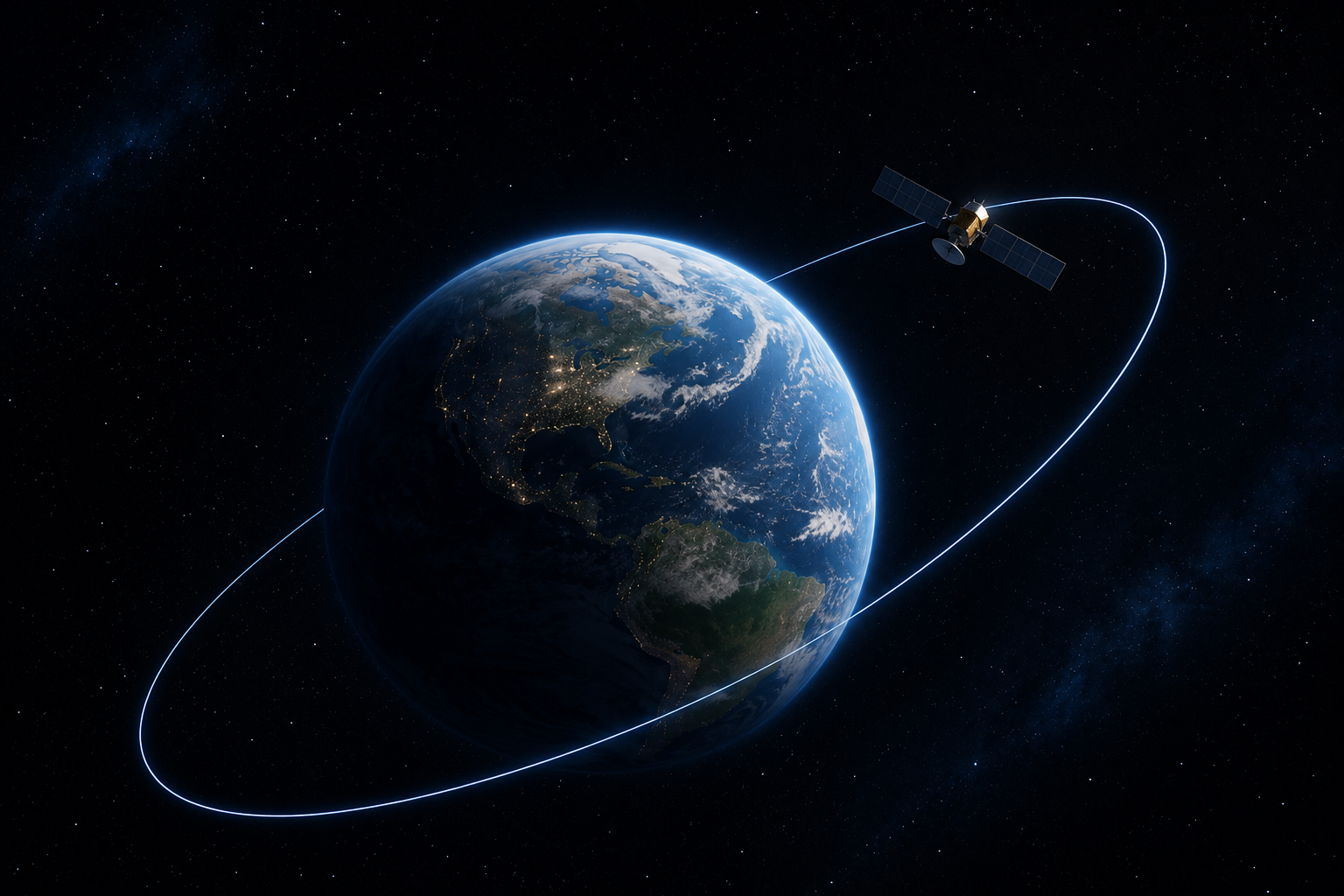
An orbit is the curved path that one object follows around another because of gravity.
Gravity continuously pulls the orbiting object toward the larger body.
At the same time, the object is moving sideways at an extremely high speed.
The result is that it continuously falls toward Earth—but keeps missing it.
This continuous "falling around Earth" is what creates an orbit.
Gravity Never Turns Off
A common misconception is that astronauts float because there is no gravity in space.
In reality, gravity remains very strong even hundreds of kilometers above Earth's surface.
For example:
- The International Space Station orbits about 400 km (250 miles) above Earth.
- At that altitude, gravity is still roughly 90% as strong as it is on Earth's surface.
Gravity never disappears.
Instead, astronauts appear weightless because they—and the spacecraft around them—are falling together around Earth.
Speed Makes Orbit Possible
Imagine throwing a baseball.
The harder you throw it, the farther it travels before gravity pulls it to the ground.
Now imagine throwing it so fast that Earth's surface curves away beneath it at the same rate it falls.
Instead of hitting the ground, it continues circling the planet.
That is exactly what an orbit is.
For spacecraft near Earth, orbital speeds are extraordinary.
A satellite in low Earth orbit travels at roughly:
28,000 km/h (17,500 mph)
At that speed, it circles Earth about every 90 minutes.
Why Spacecraft Don't Need Constant Engines
Many people imagine satellites continuously firing their engines to stay in orbit.
In reality, once a spacecraft reaches the correct speed and altitude, it usually turns its engines off.
It keeps moving because of inertia, while gravity continuously bends its path into a curved orbit.
Small engine burns are occasionally needed to:
- Correct the orbit
- Avoid collisions
- Counter atmospheric drag
- Prepare for new missions
Most of the time, however, spacecraft simply coast through space.
Different Types of Earth Orbits
Not every mission uses the same orbit.
Engineers choose an orbit based on what the spacecraft needs to accomplish.
Low Earth Orbit (LEO)
Altitude:
Approximately 160–2,000 km
Used for:
- Earth observation
- Human spaceflight
- Scientific research
- Many communication satellites
Advantages:
- Close to Earth
- Fast communication
- High-resolution imaging
Examples include the International Space Station and many Earth-imaging satellites.
Medium Earth Orbit (MEO)
Altitude:
Approximately 2,000–35,786 km
Used for:
- Navigation satellites
- Positioning systems
Examples include global navigation systems such as GPS.
These satellites cover much larger areas than those in low Earth orbit.
Geostationary Orbit (GEO)
Altitude:
Approximately 35,786 km
A satellite in this orbit circles Earth once every 24 hours—the same amount of time Earth takes to rotate.
As a result, the satellite appears to remain fixed above one location.
This makes it ideal for:
- Television broadcasting
- Weather monitoring
- Communications
Many satellite dishes point toward a single location in the sky because the satellite appears stationary.
Escaping Earth's Gravity
An orbit is not the same as leaving Earth entirely.
To travel to the Moon, Mars, or beyond, a spacecraft must reach escape velocity.
Escape velocity is approximately:
11.2 km/s (25,000 mph)
Above this speed, a spacecraft has enough energy to leave Earth's gravitational influence without falling back.
This allows missions to explore the rest of the Solar System.
Why Every Planet Has Orbits
The same physics applies everywhere.
Moons orbit planets.
Planets orbit the Sun.
Artificial satellites orbit Earth.
Even entire galaxies orbit one another over immense timescales.
Gravity is one of the fundamental forces shaping the universe.
Why Orbits Matter
Without orbits, many technologies we rely on every day would not exist.
Orbiting satellites provide:
- GPS navigation
- Weather forecasting
- Television broadcasting
- Internet connectivity
- Scientific research
- Climate monitoring
- Disaster response
- Global communications
Nearly every smartphone interacts with satellites in some way.
Understanding orbits helps us understand how these technologies work.
Key Takeaways
- An orbit is the path an object follows around another because of gravity.
- Spacecraft remain in orbit because they are moving sideways fast enough to continually fall around Earth.
- Gravity is still strong in orbit.
- Most satellites coast without continuously firing their engines.
- Different missions require different types of orbits depending on their goals.
Final Thoughts
At first glance, orbiting may seem almost magical. In reality, it is the elegant balance between gravity and motion that keeps spacecraft circling our planet.
Every satellite, space station, and planetary mission depends on these same fundamental principles. Once you understand how orbits work, many other aspects of space exploration—from rocket launches to interplanetary travel—become much easier to understand.
In the next issue, we'll explore the technology that makes reaching orbit possible by answering one of humanity's oldest engineering questions: How do rockets actually work?
Thank you for reading.