June 06, 2026
How Neural Networks Learn: A Beginner's Guide
Neural networks power many of today's most popular AI systems, including chatbots, image recognition tools, recommendation engines, and large language models. Despite their growing importance, many people find neural networks intimidating because the terminology can sound highly technical. The good news is that the core idea behind neural networks is surprisingly simple. They learn by making predictions, measuring mistakes, and gradually improving over time. While the mathematics behind the process can become complex, the underlying concepts are approachable for beginners. In this article, you'll learn how neural networks learn, what roles neurons and layers play, and why concepts such as activation functions, gradient descent, backpropagation, epochs, and batch sizes are essential to modern AI.
How Neural Networks Learn: A Beginner’s Guide
One of the biggest misconceptions about artificial intelligence is that AI systems somehow “understand” information in the same way humans do.
When people see a chatbot answer questions or an AI model identify objects in a photograph, it can feel as though the system possesses knowledge and reasoning abilities similar to a person. In reality, most AI systems learn through a process of repeated practice, feedback, and adjustment.
A helpful way to think about a neural network is to compare it to a student learning a new skill.
Imagine a student taking a practice exam. At first, many answers may be incorrect. The student reviews mistakes, learns what went wrong, and tries again. Over time, performance improves because feedback helps guide future decisions.
Neural networks learn in a similar way.
They begin with little understanding of the patterns hidden within data. They make predictions, compare those predictions against the correct answers, measure errors, and then make small adjustments. By repeating this process thousands or even millions of times, the network gradually improves.
The Building Blocks Of A Neural Network
At the center of every neural network are artificial neurons.
These neurons are inspired by biological neurons found in the human brain, although they are much simpler. Each neuron receives information, performs calculations, and passes information forward through the network.
Neurons are organized into layers.
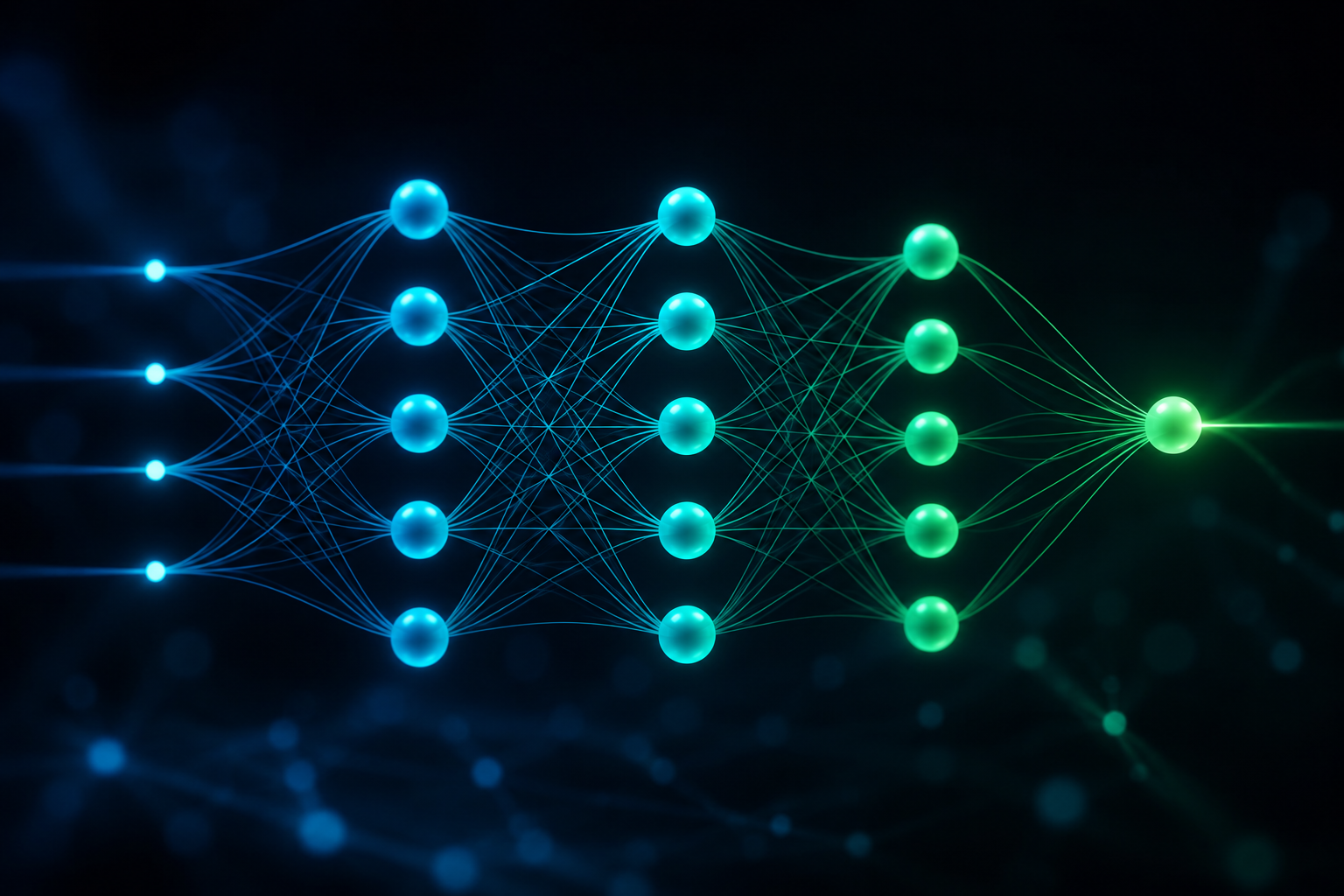
The first layer is called the Input Layer. This is where information enters the network. If a model is predicting house prices, the input layer might receive information such as location, square footage, and number of bedrooms.
The information then moves through one or more Hidden Layers. These layers help identify patterns and relationships within the data. As information passes through the network, the model gradually learns which patterns are useful for making accurate predictions.
Finally, the information reaches the Output Layer, which produces the model’s final prediction or answer.
Although neural network diagrams can look intimidating, the overall process is straightforward: information enters, gets processed, and produces an output.
Why Activation Functions Matter
Not every piece of information should influence a prediction equally.
This is where activation functions become important.
An activation function helps determine how strongly a neuron should respond to incoming information. In simple terms, it decides whether certain information should be emphasized, reduced, or ignored.
A helpful analogy is a hiring manager reviewing job applications.
Some qualifications may be highly important for a particular role, while others may have little impact on the final decision. Activation functions help neural networks make similar decisions about which patterns deserve more attention.
Without activation functions, neural networks would struggle to learn complex relationships within data.
Learning Through Mistakes
The real learning process begins after a prediction is made.
Suppose a neural network is trying to identify whether an image contains a cat. It examines the image and makes a prediction.
If the prediction is correct, great.
If the prediction is wrong, the network needs to learn from that mistake.
The difference between the prediction and the correct answer is called the error. This error provides feedback that helps the network improve.
Just as a student learns by reviewing incorrect answers, a neural network learns by analyzing prediction errors.
The goal is simple: reduce future mistakes.
What Is Gradient Descent?
One of the most important concepts in machine learning is Gradient Descent.
Gradient Descent is an optimization process that helps a neural network gradually improve its predictions.
Imagine standing on a foggy mountain and trying to reach the lowest point in the valley. You cannot see the entire landscape, but you can determine which direction slopes downward. By repeatedly taking small steps downhill, you eventually move closer to the bottom.
Gradient Descent works in a similar way.
The neural network uses errors as guidance and makes small adjustments that move it toward better performance. Each adjustment helps reduce future prediction errors.
Rather than trying to find the perfect solution immediately, the network improves gradually through many small improvements.
What Is Backpropagation?
If Gradient Descent determines how to improve, Backpropagation determines where improvements should be made.
After the network makes a prediction and calculates an error, backpropagation sends that feedback backward through the network. This process helps identify which neurons and connections contributed to the mistake.
The network can then adjust those connections to improve future predictions.
A useful analogy is a teacher reviewing a student’s exam and identifying exactly which questions were answered incorrectly. Instead of simply saying “you got a poor score,” the teacher highlights specific mistakes that need improvement.
Backpropagation provides that detailed feedback to the neural network.
Together, Gradient Descent and Backpropagation form the foundation of how modern neural networks learn.
Epochs And Batch Size
Learning does not happen after seeing a single example.
Neural networks typically train on large datasets containing thousands or millions of examples.
An Epoch represents one complete pass through the entire training dataset. If a dataset contains 10,000 examples, one epoch means the model has reviewed all 10,000 examples once.
Most neural networks require multiple epochs before they learn useful patterns.
Another important concept is Batch Size.
Rather than processing the entire dataset at once, the model usually processes smaller groups of examples called batches. The batch size determines how many examples are reviewed before the network updates its internal parameters.
Smaller batches often make training more flexible, while larger batches can improve efficiency. Choosing the right batch size depends on the specific problem being solved.
Key Takeaways
- Neural networks learn through prediction, feedback, and improvement.
- Artificial neurons are the basic building blocks of neural networks.
- Input layers receive information, hidden layers process it, and output layers generate predictions.
- Activation functions help determine which information matters most.
- Gradient Descent helps reduce prediction errors over time.
- Backpropagation identifies where adjustments should be made.
- Epochs represent complete passes through training data.
- Batch Size determines how many examples are processed at one time.
Conclusion
At first glance, neural networks can seem intimidating because of the terminology surrounding them. However, the core learning process is surprisingly simple.
A neural network receives information, makes predictions, measures mistakes, and improves through repeated feedback. Concepts such as activation functions, gradient descent, backpropagation, epochs, and batch sizes all support this learning process.
Understanding these fundamentals provides a strong foundation for exploring more advanced AI topics. More importantly, it helps demystify one of the technologies powering many of the AI systems people interact with every day.
Neural networks may be complex under the hood, but the idea behind their learning process is something most people already understand:
Practice, feedback, and gradual improvement.