May 29, 2026
AI vs Machine Learning vs Generative AI: Understanding the Difference
Artificial Intelligence, Machine Learning, and Generative AI are often discussed as if they are the same thing. In reality, they represent different layers of modern AI technology. This guide explains how they relate to one another, where they are used, and why understanding the difference is essential for building AI literacy.
AI vs Machine Learning vs Generative AI: What’s the Difference?
Artificial intelligence has become impossible to ignore.
It appears in workplace meetings, university classrooms, news headlines, social media feeds, and everyday software products. People use AI to generate images, write emails, summarize documents, answer questions, create presentations, and help solve problems.
At the same time, the language surrounding AI has become increasingly confusing.
Artificial Intelligence.
Machine Learning.
Generative AI.
These terms are often used as if they mean the same thing.
They do not.
In fact, much of the confusion surrounding modern AI comes from people discussing different technologies while using the same general vocabulary.
Someone might say their company is investing in AI.
A news article might discuss machine learning.
A friend might be experimenting with ChatGPT or an AI image generator.
All three conversations involve AI, but they are not necessarily talking about the same thing.
Understanding the difference is one of the most important foundations of AI literacy.
Because before we can discuss how AI is changing business, education, healthcare, cybersecurity, or everyday life, we first need to understand what these terms actually mean.
And fortunately, the distinction is much simpler than many people think.
The Easiest Way to Understand the Relationship
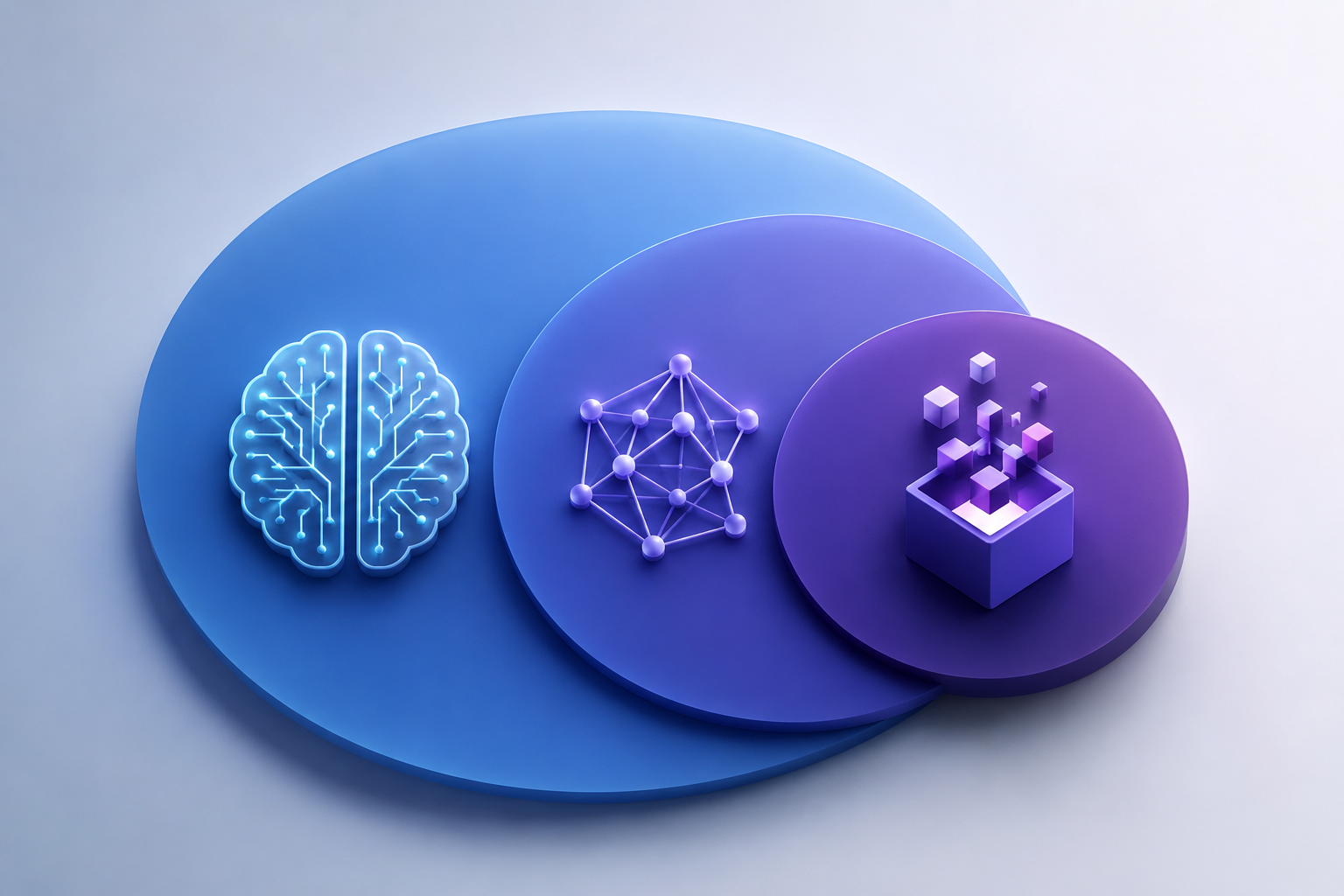
Imagine a set of nested boxes.
The largest box is Artificial Intelligence.
Inside that box is Machine Learning.
And inside Machine Learning is much of what powers today’s Generative AI systems.
In other words:
Generative AI is part of Machine Learning.
Machine Learning is part of Artificial Intelligence.
Understanding that hierarchy immediately clears up much of the confusion.
Artificial Intelligence is the broad category.
Machine Learning is one approach used to build AI systems.
Generative AI is a specific type of AI application that creates new content.
Let’s look at each one individually.
Artificial Intelligence: The Big Umbrella
Artificial Intelligence is the broad field focused on building computer systems that can perform tasks that normally require human intelligence.
That sounds complicated, but the idea is surprisingly straightforward.
Whenever a computer system performs a task that once required significant human judgment, decision-making, or pattern recognition, it is often considered a form of AI.
Those tasks might include:
- recognizing speech
- identifying objects in images
- translating languages
- recommending products
- detecting fraud
- answering questions
- making predictions
Notice that none of these examples require a robot.
This is one of the most common misconceptions about artificial intelligence.
When many people hear the term AI, they imagine human-like machines from science fiction movies.
In reality, most AI exists quietly in software systems people use every day.
When a streaming platform recommends a movie you might enjoy, AI is often involved.
When a navigation app predicts traffic conditions, AI may be involved.
When your email service filters spam messages, AI is likely helping behind the scenes.
Artificial Intelligence is not one specific technology.
It is an umbrella term that includes many different techniques and approaches.
One of the most important of those approaches is Machine Learning.
Machine Learning: Teaching Computers Through Data
For decades, traditional software worked by following rules written directly by programmers.
A developer would define the instructions.
The computer would follow them.
If the rules were correct, the software would behave as expected.
But some problems are difficult to solve using fixed rules.
Imagine trying to write software that can recognize every possible photo of a dog.
Some dogs are large.
Some are small.
Some have long fur.
Others have short fur.
Lighting conditions change.
Camera angles change.
Backgrounds change.
The number of possible variations becomes enormous.
Writing rules for every scenario quickly becomes unrealistic.
Machine Learning approaches the problem differently.
Instead of telling the computer exactly what to look for, developers provide large amounts of data.
The system studies that data and begins identifying patterns on its own.
Over time, it becomes increasingly effective at recognizing similarities and making predictions.
In simple terms, machine learning allows computers to learn from examples rather than relying entirely on explicit instructions.
This ability has transformed industries around the world.
Banks use machine learning to detect unusual transactions.
Retailers use it to recommend products.
Healthcare organizations use it to help identify medical risks.
Streaming platforms use it to personalize recommendations.
Many of the AI systems people interact with every day are powered by machine learning.
But even machine learning is not the end of the story.
In recent years, a new category of AI has captured global attention.
That category is Generative AI.
Generative AI: Creating Instead of Predicting
Most AI systems spend their time analyzing information.
Generative AI does something different.
It creates.
Instead of simply identifying patterns, classifying information, or making predictions, Generative AI produces entirely new content.
That content may include:
- text
- images
- audio
- video
- software code
- summaries
- reports
- conversations
This is why Generative AI feels so different from earlier generations of AI technology.
When you ask an AI assistant to explain a concept, write a draft, summarize a document, or brainstorm ideas, it is creating something new in response to your request.
The same is true when an AI image generator produces artwork from a text prompt.
Or when an AI coding assistant generates software code.
Or when a language model creates a detailed explanation of a complex topic.
The system is not simply retrieving information from a database.
It is generating new content based on patterns learned during training.
This capability is what has made Generative AI one of the fastest-adopted technologies in modern history.
Why People Often Confuse These Terms
Part of the confusion comes from timing.
For many people, Generative AI was their first meaningful interaction with artificial intelligence.
Tools like ChatGPT suddenly made AI feel personal, conversational, and accessible.
As a result, many people began using the term AI when they were specifically referring to Generative AI.
But Generative AI is only one piece of a much larger picture.
Fraud detection systems use AI.
Recommendation engines use AI.
Spam filters use AI.
Autonomous vehicles use AI.
Medical imaging systems use AI.
Most of these systems are not generating content at all.
They are analyzing, predicting, identifying, or optimizing.
Generative AI simply happens to be the area that has attracted the most public attention in recent years.
Why This Difference Matters
At first glance, these distinctions may seem like technical details.
In reality, they shape how people understand the opportunities and limitations of modern technology.
When someone understands the difference between Artificial Intelligence, Machine Learning, and Generative AI, they can evaluate new tools more clearly.
They can ask better questions.
They can make better decisions.
And they are less likely to be influenced by hype, fear, or unrealistic expectations.
AI literacy is becoming increasingly valuable not because everyone needs to become an AI engineer, but because AI is becoming part of everyday life.
Understanding the fundamentals helps people navigate that future with greater confidence.
Key Takeaways
Artificial Intelligence is the broad field focused on building systems capable of performing tasks associated with human intelligence.
Machine Learning is one of the primary methods used to build modern AI systems by allowing computers to learn patterns from data.
Generative AI is a specialized area of AI that creates new content such as text, images, audio, video, and software code.
The three concepts are connected, but they are not interchangeable.
Understanding the difference is one of the first and most important steps toward building genuine AI literacy.
Conclusion
Artificial intelligence is often presented as a mysterious force transforming the world overnight.
The reality is both simpler and more interesting.
AI is a broad field.
Machine Learning is one of its most important tools.
Generative AI is one of its newest and most visible applications.
Once those relationships become clear, many conversations about AI suddenly make much more sense.
And as AI continues to influence business, education, cybersecurity, government, and everyday life, that understanding becomes increasingly valuable.
Because the goal is not simply to use AI.
The goal is to understand it.